INSTANT STREAMING COURSE
Share:

Risk Management and Impact Assessments in Change Control

This course provides practical methods for evaluating change impact, integrating risk-based decision making, and strengthening change control procedures to reduce product, regulatory, and cross-functional operational exposure in regulated pharmaceutical and medical device environments. This Course is designed for professionals responsible for regulated product changes, quality oversight, compliance decisions, and operational controls.

REGISTER FOR THE COURSE

US $190 per learner

30-Days Unlimited Streaming Access

/* Hide default + / - icon */ .accordion-toggle-icon { opacity: 0; } /* Add circle instead */ .accordion-header::after { content: "○"; font-size: 18px; margin-left: auto; transition: 0.2s ease; } /* When open → filled circle */ .accordion-item.active .accordion-header::after { content: "●"; } /* Hide default + / - icon */ .accordion-toggle-icon { opacity: 0; } /* Add circle instead */ .accordion-header::after { content: "○"; font-size: 18px; margin-left: auto; transition: 0.2s ease; } /* When open → filled circle */ .accordion-item.active .accordion-header::after { content: "●"; } .accordion-header::after { content: "◯"; font-size: 18px; transition: transform 0.25s ease; } .accordion-item.active .accordion-header::after { transform: rotate(90deg); }

REGISTER FOR THE COURSE

To Get 30-Day Access to ONLY this Course 

US $190 per learner
  • This course is Included in Subscription Pack
Subscription include access to entire Learning Library
/* Hide default + / - icon */ .accordion-toggle-icon { opacity: 0; } /* Add circle instead */ .accordion-header::after { content: "○"; font-size: 18px; margin-left: auto; transition: 0.2s ease; } /* When open → filled circle */ .accordion-item.active .accordion-header::after { content: "●"; } /* Hide default + / - icon */ .accordion-toggle-icon { opacity: 0; } /* Add circle instead */ .accordion-header::after { content: "○"; font-size: 18px; margin-left: auto; transition: 0.2s ease; } /* When open → filled circle */ .accordion-item.active .accordion-header::after { content: "●"; } .accordion-header::after { content: "◯"; font-size: 18px; transition: transform 0.25s ease; } .accordion-item.active .accordion-header::after { transform: rotate(90deg); }
  • Faculty
    Alan M. Golden
  • Duration
    60 Minutes
  • Course ID
    TF3592
  • Ask the Expert
    Included
  • Presentation Handout
    & Templates
  • Assessment
    & Certification Included

About the Course

Change control failures remain a common concern during regulatory audits and product nonconformance investigations within pharmaceutical and medical device operations. Changes made without sufficient impact assessment or risk evaluation can negatively affect product performance, compromise validation activities, or unintentionally influence related products and processes. Effective change management requires structured assessment methods that support informed implementation decisions and appropriate verification activities.


This course focuses on the operational role of impact assessments within the broader change control process and the importance of integrating risk management before, during, and after a change is introduced. Particular attention is given to defining low-impact changes, establishing practical internal procedures, and developing decision-making tools that guide consistent assessments. The session also addresses the formation of assessment teams, the use of change control roadmaps, and the importance of documenting justification decisions that support regulatory expectations and internal quality system requirements.

  • Build More Reliable Change Assessment Decisions:

    Participants will gain practical approaches for evaluating the operational and regulatory impact of proposed changes before implementation. The course clarifies how impact assessments support justification decisions, verification activities, and validation requirements while reducing the likelihood of overlooked product risks, ineffective documentation practices, or audit observations tied to inadequate change evaluations.

  • Strengthen Risk-Based Change Control Procedures:

    The session provides structured methods for incorporating risk management into routine change control activities using practical assessment tools, decision trees, and defined review processes. Organizations operating in regulated environments face increasing scrutiny around change documentation and cross-functional impact evaluation, making consistent internal procedures essential for maintaining product quality and compliance expectations.

Key Areas Covered

  • The operational role of impact assessments within the change control process
  • Regulatory expectations for reviewing, verifying, and validating changes as appropriate
  • Structuring change descriptions, justification requirements, and supporting documentation
  • Defining and managing low-impact changes within internal SOP requirements
  • Building and organizing impact assessment teams for change evaluation activities
  • Developing change control roadmaps using forms, decision trees, and assessment records
  • Integrating risk management considerations before, during, and after change implementation
  • Understanding regulatory and cross-product operational impact during change execution

Who Must Attend

  • QA/QC Departments
  • Regulatory Affairs Teams
  • R&D Teams
  • Manufacturing, Engineering & Operations
  • Production & Validation Professionals
  • GMP Trainers & Auditors
  • Consultants

Quality training, expert insights, and answers that matter. Know your Expert

ALAN M. GOLDEN

Alan has more than 30 years of medical device industry experience spanning research, quality assurance, and regulated product support. During his tenure at Abbott Laboratories, he held quality assurance responsibilities involving design control, change control, risk management, CAPA, validation, and quality systems oversight across development and operations. His experience includes implementing and supporting controlled change processes within regulated environments, along with delivering global training programs focused on quality assurance and compliance-related practices.

If you would like to request a Proforma invoice to sign up for this course. please click here

Commonly Asked Questions About This Subject

The following questions address practical regulatory, compliance, validation, quality, operational, and inspection-related considerations commonly associated with this subject.

How can a change be justified as low risk when its long term effects cannot be fully predicted?

A change can be justified as low risk only when the available evidence demonstrates that uncertainty has been evaluated rather than ignored. Inspectors expect documented reasoning showing why the remaining uncertainty is acceptable and how it will be monitored after implementation.


The justification should rely on objective evidence such as product knowledge, process capability, validation history, complaint trends, stability data, and previous change experience. A conclusion based primarily on expert opinion becomes increasingly difficult to defend when supporting data is limited.


Reviewers also examine whether potential indirect effects were considered. Changes affecting suppliers, software, equipment, specifications, or manufacturing conditions often create downstream consequences that are overlooked during initial assessments but become apparent during inspections or investigations.


Well supported decisions acknowledge residual risk instead of presenting complete certainty. Documentation describing the basis for the decision, planned verification activities, and post implementation monitoring demonstrates that uncertainty was managed through a controlled process rather than accepted without evaluation.

What documentation weaknesses most often undermine the credibility of a change impact assessment during an inspection?

Inspectors frequently question impact assessments that explain what was decided but provide little evidence showing how those conclusions were reached. Documentation should demonstrate the reasoning process instead of simply recording the final decision.


One recurring weakness involves unsupported statements that a change has no effect on validation, product quality, regulatory filings, or related systems. Conclusions without documented technical evaluation are difficult to defend when inspectors request the supporting evidence.


Assessment records should also remain consistent with associated quality documents. Differences between change controls, validation reports, deviation investigations, risk assessments, or engineering records often suggest that departments reached different conclusions about the same change.


Strong documentation allows an independent reviewer to follow the assessment from the original proposal through implementation and verification. When supporting evidence, approvals, and technical evaluations remain traceable throughout the record, inspection discussions become more straightforward.

How do inspectors distinguish between an isolated change control weakness and evidence of broader quality system deficiencies?

Inspectors rarely evaluate a change control record by itself. They compare multiple changes over time to determine whether decision making remains consistent across products, departments, and manufacturing operations.


Patterns receive considerable attention. Repeated incomplete impact assessments, recurring implementation delays, similar documentation deficiencies, or repeated post implementation corrections may indicate weaknesses extending beyond individual change records.


Inspection teams also compare change controls with deviations, CAPAs, complaints, audit findings, and validation activities. Similar issues appearing across different quality processes often suggest that risk evaluation and management oversight are not functioning effectively.


Confidence increases when records demonstrate consistent technical reviews, documented challenge of proposed changes, and measurable follow up after implementation. Evidence showing that previous assessment weaknesses led to procedural improvements supports the conclusion that isolated issues did not become systemic failures.

When should a previously approved change be reassessed before implementation?

Approval does not eliminate the need for reassessment when important conditions change before implementation. Inspectors expect organizations to recognize when the original impact assessment no longer reflects current operating conditions or available information.


New validation results, supplier changes, complaint trends, process deviations, regulatory commitments, or engineering modifications may significantly alter the assumptions supporting the original decision. Proceeding without revisiting the assessment can weaken the justification for implementation.


The reassessment should focus on whether the original risk evaluation remains valid rather than repeating the entire review process. Documented consideration of new information demonstrates that change control decisions continue to reflect current product and process knowledge.


Well controlled reassessments provide a clear record explaining why the original decision was confirmed or revised. Evidence that approvals were reconsidered in light of changing circumstances is generally more persuasive than relying on documentation prepared months earlier without further evaluation.

Ready to Strengthen Your Team? Let’s Build Your Training Plan.

Whether you’re looking for a single onsite workshop or a multi-team training series, we’ll help you design a program that fits your goals, timelines, and operational reality.

Your team deserves the clarity.
Your organization deserves the confidence.

Upcoming Courses

Your TalkFDA Webinar Experience

When you reserve your seat, everything is organized for you — from access to certification from one place.

1. Confirmation

You receive a confirmation email and your course appears instantly in your TalkFDA dashboard.

2. Your Course Hub
Your TalkFDA course page becomes your central hub where you can watch the course, access materials, and manage your learning.

3. Access course materials
The presentation handout and other materials can be downloaded inside the Course Player. You could use Discussion feature there to ask your questions.

4. Watch The Streaming and Complete your Course
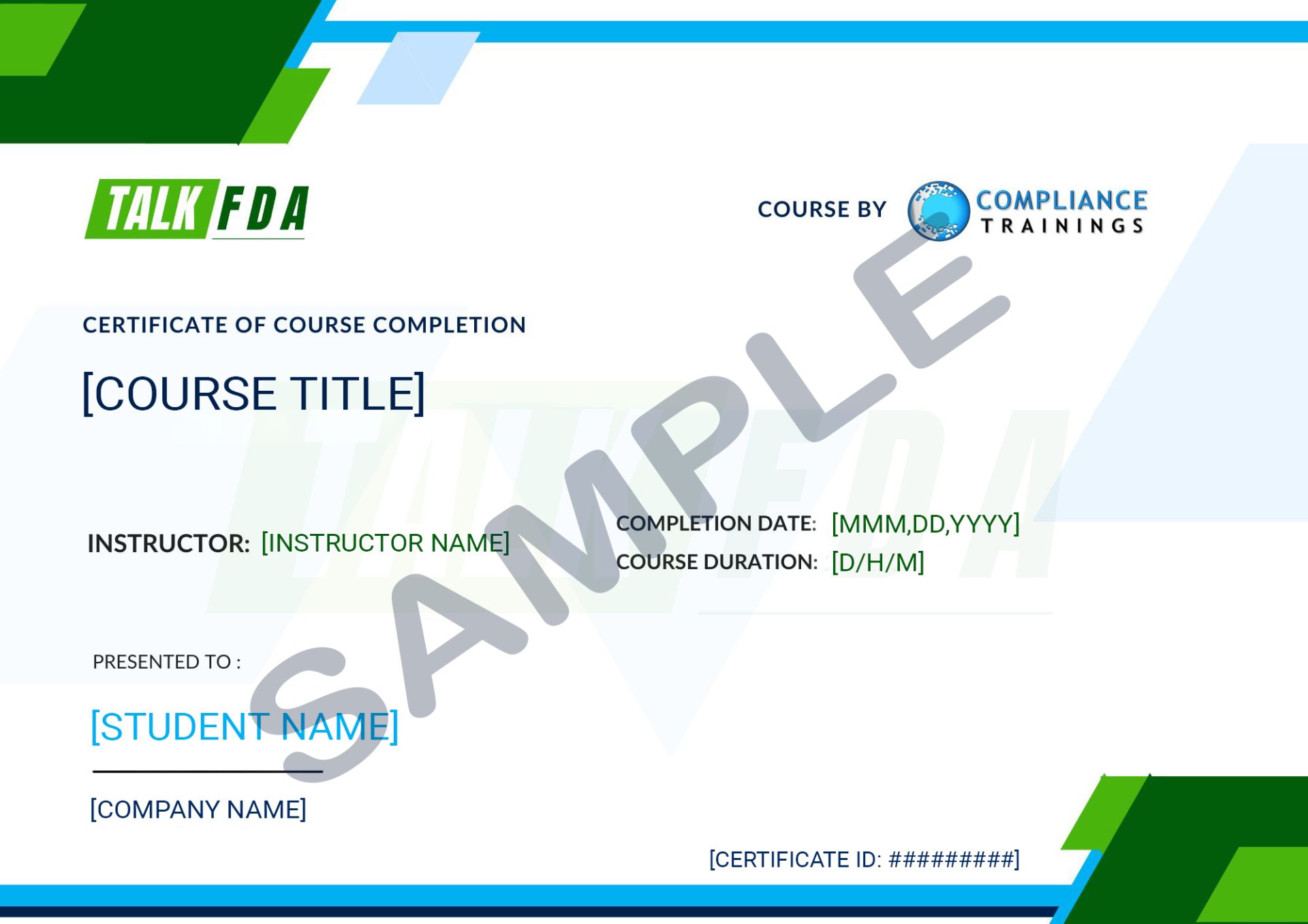
The course playback will be available on the same course page. You could pause and continue or you can revisit important sections.
5. Earn Your Certificate
Complete the course and your certificate is unlocked automatically in your learning history.

The challenge with training is rarely signing up. It’s what happens afterward, when access, materials, & certification aren’t accessible from one place.
With TalkFDA Courses, Everything you need Live in One Place.
Simple. Organized. Professional.
Go ahead and Take the Course with confidence.

Our students love us ❤️

“Some parts we already knew, but the way it was explained made it easier to apply. We ended up revisiting our internal approach after this.”

Senior Manager, Regulatory Affairs

“Team found it useful. Especially for aligning understanding across functions.”

Manager, Operations

“Presenter knew where to spend time and where to move quickly. That made a difference.”

Director, Quality Assurance

People who took this Course, also viewed