INSTANT STREAMING COURSE
Share:

Practical Implementation Of Pharmaceutical Quality Risk Management (QRM)

This course equips pharmaceutical professionals to apply Quality Risk Management principles consistently across quality processes, improving risk-based decision making through structured evaluation of severity, occurrence, and detectability while reducing confusion around QRM implementation and tool selection. This Course is designed for professionals responsible for pharmaceutical quality processes, risk evaluation, compliance, and operational decision making.

REGISTER FOR THE COURSE

US $190 per learner

30-Days Unlimited Streaming Access

/* Hide default + / - icon */ .accordion-toggle-icon { opacity: 0; } /* Add circle instead */ .accordion-header::after { content: "○"; font-size: 18px; margin-left: auto; transition: 0.2s ease; } /* When open → filled circle */ .accordion-item.active .accordion-header::after { content: "●"; } /* Hide default + / - icon */ .accordion-toggle-icon { opacity: 0; } /* Add circle instead */ .accordion-header::after { content: "○"; font-size: 18px; margin-left: auto; transition: 0.2s ease; } /* When open → filled circle */ .accordion-item.active .accordion-header::after { content: "●"; } .accordion-header::after { content: "◯"; font-size: 18px; transition: transform 0.25s ease; } .accordion-item.active .accordion-header::after { transform: rotate(90deg); }

REGISTER FOR THE COURSE

To Get 30-Day Access to ONLY this Course 

US $190 per learner
  • This course is Included in Subscription Pack
Subscription include access to entire Learning Library
/* Hide default + / - icon */ .accordion-toggle-icon { opacity: 0; } /* Add circle instead */ .accordion-header::after { content: "○"; font-size: 18px; margin-left: auto; transition: 0.2s ease; } /* When open → filled circle */ .accordion-item.active .accordion-header::after { content: "●"; } /* Hide default + / - icon */ .accordion-toggle-icon { opacity: 0; } /* Add circle instead */ .accordion-header::after { content: "○"; font-size: 18px; margin-left: auto; transition: 0.2s ease; } /* When open → filled circle */ .accordion-item.active .accordion-header::after { content: "●"; } .accordion-header::after { content: "◯"; font-size: 18px; transition: transform 0.25s ease; } .accordion-item.active .accordion-header::after { transform: rotate(90deg); }
  • Faculty
    Steven Laurenz
  • Duration
    60 Minutes
  • Course ID
    TF2302
  • Ask the Expert
    Included
  • Presentation Handout
    & Templates
  • Assessment
    & Certification Included

About the Course

Quality Risk Management remains a central expectation within pharmaceutical quality systems, particularly under ICH Q10, yet many organizations continue to struggle with consistent implementation across routine quality activities. Confusion often arises when risk management is treated only as an individual assessment tool rather than a structured process supporting scientifically based quality decisions. Clear understanding of severity, occurrence, detectability, and overall risk evaluation is necessary for reliable decision making and effective control of quality-related issues.

The course establishes practical understanding of core QRM terminology, the four primary components of Quality Risk Management, and the application of commonly used risk management tools within pharmaceutical operations. Attention is given to how risk levels are defined and interpreted, allowing professionals to apply QRM principles more consistently within existing quality processes. The material also clarifies the relationship between formal risk tools and broader QRM expectations within an effective pharmaceutical quality system.
  • Consistent Risk-Based Quality Decisions:

    Organizations frequently apply risk tools inconsistently because the underlying QRM process is not clearly understood. This course strengthens the ability to assess severity, occurrence, and detectability within a structured decision process, helping teams support quality actions with clearer rationale and better alignment to pharmaceutical quality system expectations, including principles referenced in ICH Q10.

  • Clearer Application of QRM Tools:

    Many pharmaceutical organizations struggle to distinguish between individual risk assessment tools and a complete Quality Risk Management approach. The course clarifies key terminology, core QRM components, and practical application of risk tools, supporting more consistent quality process execution and reducing operational uncertainty during risk evaluation and quality-related decision activities.

Key Areas Covered

  • Core terminology associated with pharmaceutical Quality Risk Management
  • The four primary components of an effective QRM process
  • Risk evaluation using severity, occurrence, and detectability criteria
  • Application of QRM principles within pharmaceutical quality processes
  • Examples of risk management tools and appropriate operational use
  • Relationship between QRM implementation and ICH Q10 pharmaceutical quality system expectations

Who Must Attend

  • Process Owners
  • Quality Auditors & Engineers
  • Quality & Compliance Professionals
  • Production Engineers & Supervisors
  • Senior Quality Managers
  • Regulatory Professionals
  • Manufacturing Engineers
  • Development Professionals & Managers

Quality training, expert insights, and answers that matter. Know your Expert

STEVEN LAURENZ

Steven Laurenz is Principal Consultant at BioPhia Consulting Inc. with more than 25 years of experience across product development, process development, technology transfer, and pharmaceutical quality systems. His work has included integrating Quality by Design and risk management into product development activities and establishing quality systems for R&D Quality Assurance organizations. He previously led product development functions at Abbott Laboratories and AbbVie Inc. and holds an M.S. in Chemical Engineering from Michigan State University.

If you would like to request a Proforma invoice to sign up for this course. please click here

Commonly Asked Questions About This Subject

The following questions address practical regulatory, compliance, validation, quality, operational, and inspection-related considerations commonly associated with this subject.

How should organizations determine when a formal Quality Risk Management assessment is necessary?

A formal Quality Risk Management assessment should be performed when a decision has the potential to affect product quality, patient safety, regulatory compliance, or established control strategies. Applying the same level of risk assessment to every issue can consume resources without improving decision quality.


The decision should consider the significance of the proposed change, the level of uncertainty, available scientific knowledge, historical performance, and whether existing procedures already address the identified risk. Routine activities supported by established controls may not require a comprehensive assessment, while novel or high impact situations often do.


Inspection concerns frequently arise when organizations cannot explain why a formal risk assessment was completed for one issue but omitted for another with similar potential impact. Inconsistent application of QRM can create the impression that risk assessments are performed to satisfy documentation requirements rather than to support quality decisions.


Organizations that define clear criteria for initiating formal QRM activities are generally better positioned to demonstrate consistent decision making. A structured approach helps ensure that risk assessments are applied where they provide meaningful value instead of becoming a routine administrative exercise.

Why do similar quality issues often receive different risk ratings across departments?

Different risk ratings often result from inconsistent assumptions rather than differences in the quality issue itself. Teams may evaluate the same event using different process knowledge, historical experience, or interpretations of severity, occurrence, and detectability.


Variations also occur when departments apply different acceptance criteria or rely on incomplete information during the assessment. Without a shared understanding of risk evaluation principles, identical issues can produce significantly different conclusions across manufacturing, quality, engineering, or regulatory functions.


Inspection questions commonly arise when comparable quality events receive different risk classifications without documented scientific justification. These inconsistencies can make it difficult to demonstrate that quality decisions are based on objective criteria rather than individual judgment.


Organizations that establish standardized evaluation criteria and encourage cross functional participation are generally more successful in achieving consistent risk assessments. Shared decision making strengthens confidence that risk ratings reflect the available evidence instead of departmental perspectives.

How should organizations determine whether existing risk controls remain effective over time?

Risk controls should be evaluated using objective performance data rather than assuming they continue to perform as originally intended. Changes in manufacturing, suppliers, equipment, product knowledge, or operating conditions can reduce the effectiveness of controls that were previously considered adequate.


The review should include trends in deviations, complaints, investigations, process performance, environmental monitoring, audit findings, and other quality indicators relevant to the identified risk. Looking at multiple sources of evidence provides a more reliable picture of control effectiveness than isolated observations.


Inspection concerns frequently arise when organizations continue to reference historical risk assessments despite evidence that operating conditions have changed. Controls that were effective during initial implementation may require adjustment as processes evolve or new information becomes available.


Organizations that periodically review the performance of existing risk controls are generally better prepared to demonstrate an active Quality Risk Management process. Ongoing verification supports timely improvements and helps ensure that quality decisions remain appropriate throughout the product lifecycle.

How should organizations establish risk based governance for significant pharmaceutical quality decisions?

Risk based governance should define when important quality decisions require additional technical, quality, or management review before implementation. A structured governance process promotes consistent oversight for decisions that have the potential to affect product quality, patient safety, or regulatory compliance.


Governance criteria should consider factors such as product impact, process complexity, scientific uncertainty, recurrence of quality issues, regulatory significance, and the potential consequences of an incorrect decision. Establishing these criteria in advance helps ensure that similar issues receive a consistent level of review.


Inspection observations often identify situations where comparable quality decisions follow different approval pathways without documented justification. Inconsistent governance can weaken confidence that decisions are made using established quality system expectations rather than individual preference.


Organizations that define governance thresholds before significant issues arise are generally better positioned during inspections and regulatory reviews. A documented framework supports objective oversight, reduces unnecessary rework, and demonstrates that major quality decisions follow a consistent and scientifically justified process.

Ready to Strengthen Your Team? Let’s Build Your Training Plan.

Whether you’re looking for a single onsite workshop or a multi-team training series, we’ll help you design a program that fits your goals, timelines, and operational reality.

Your team deserves the clarity.
Your organization deserves the confidence.

Upcoming Courses

Your TalkFDA Webinar Experience

When you reserve your seat, everything is organized for you — from access to certification from one place.

1. Confirmation

You receive a confirmation email and your course appears instantly in your TalkFDA dashboard.

2. Your Course Hub
Your TalkFDA course page becomes your central hub where you can watch the course, access materials, and manage your learning.

3. Access course materials
The presentation handout and other materials can be downloaded inside the Course Player. You could use Discussion feature there to ask your questions.

4. Watch The Streaming and Complete your Course
The course playback will be available on the same course page. You could pause and continue or you can revisit important sections.
5. Earn Your Certificate
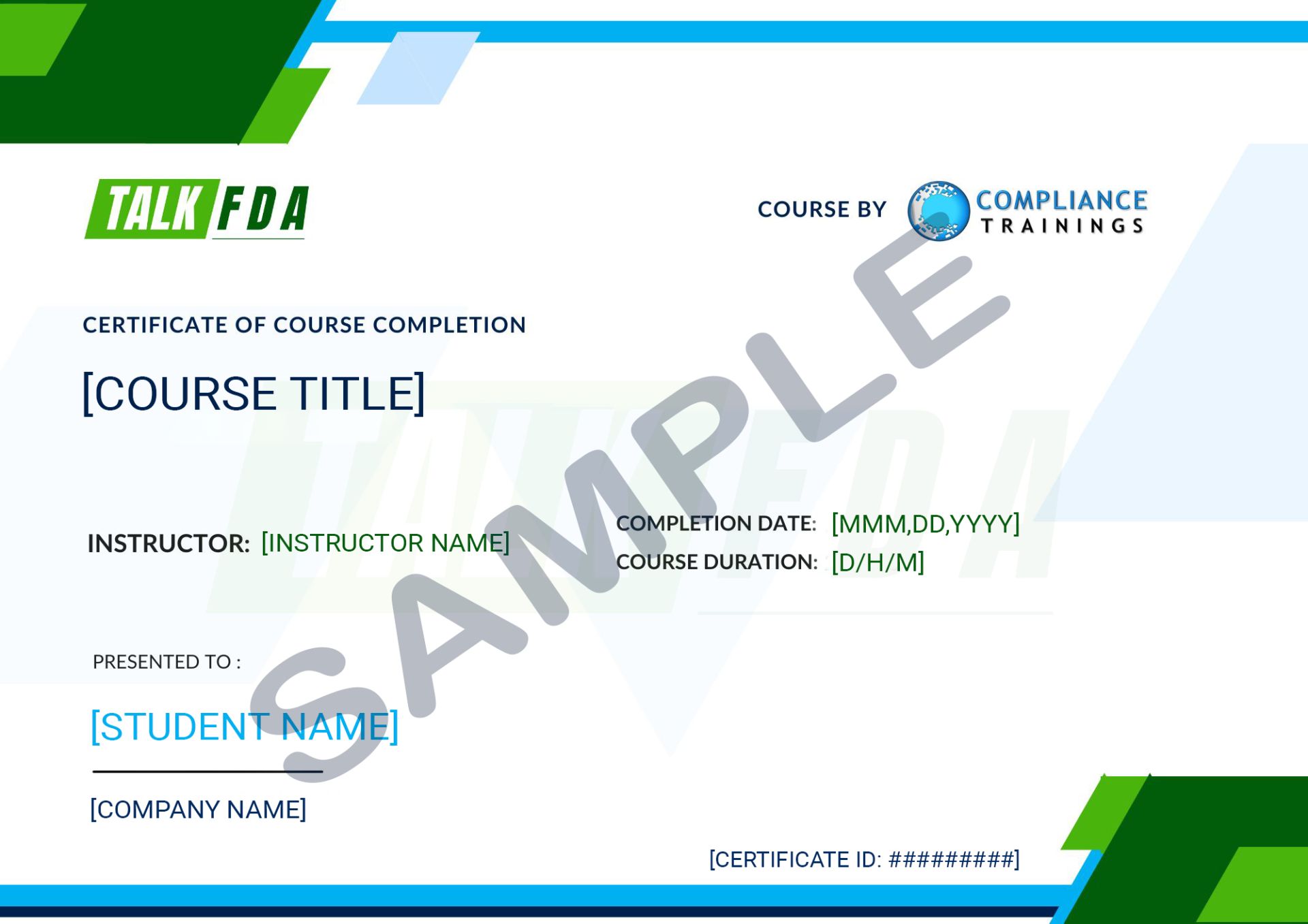
Complete the course and your certificate is unlocked automatically in your learning history.

The challenge with training is rarely signing up. It’s what happens afterward, when access, materials, & certification aren’t accessible from one place.
With TalkFDA Courses, Everything you need Live in One Place.
Simple. Organized. Professional.
Go ahead and Take the Course with confidence.

Our students love us ❤️

“Presenter didn’t overcomplicate things. Kept it moving. That helped keep the team engaged.”


Director, Manufacturing

“Some good points came up during Q&A. That part was useful for us.”

Auditor, Compliance

“Length was fine. Could sit through without losing focus.”


Supervisor, Manufacturing

People who took this Course, also viewed