INSTANT STREAMING COURSE
Share:

Laboratory Safety – All You Need to Know

This course equips laboratory personnel to implement practical safety controls, manage chemical handling responsibilities, and respond effectively to workplace incidents. Participants gain operational guidance for maintaining compliant laboratory practices, emergency readiness, and safe day-to-day laboratory conditions. This Course is designed for professionals responsible for laboratory operations, workplace safety, chemical handling, and emergency preparedness.

REGISTER FOR THE COURSE

US $190 per learner

30-Days Unlimited Streaming Access

/* Hide default + / - icon */ .accordion-toggle-icon { opacity: 0; } /* Add circle instead */ .accordion-header::after { content: "○"; font-size: 18px; margin-left: auto; transition: 0.2s ease; } /* When open → filled circle */ .accordion-item.active .accordion-header::after { content: "●"; } /* Hide default + / - icon */ .accordion-toggle-icon { opacity: 0; } /* Add circle instead */ .accordion-header::after { content: "○"; font-size: 18px; margin-left: auto; transition: 0.2s ease; } /* When open → filled circle */ .accordion-item.active .accordion-header::after { content: "●"; } .accordion-header::after { content: "◯"; font-size: 18px; transition: transform 0.25s ease; } .accordion-item.active .accordion-header::after { transform: rotate(90deg); }

REGISTER FOR THE COURSE

To Get 30-Day Access to ONLY this Course 

US $190 per learner
  • This course is Included in Subscription Pack
Subscription include access to entire Learning Library
/* Hide default + / - icon */ .accordion-toggle-icon { opacity: 0; } /* Add circle instead */ .accordion-header::after { content: "○"; font-size: 18px; margin-left: auto; transition: 0.2s ease; } /* When open → filled circle */ .accordion-item.active .accordion-header::after { content: "●"; } /* Hide default + / - icon */ .accordion-toggle-icon { opacity: 0; } /* Add circle instead */ .accordion-header::after { content: "○"; font-size: 18px; margin-left: auto; transition: 0.2s ease; } /* When open → filled circle */ .accordion-item.active .accordion-header::after { content: "●"; } .accordion-header::after { content: "◯"; font-size: 18px; transition: transform 0.25s ease; } .accordion-item.active .accordion-header::after { transform: rotate(90deg); }
  • Faculty
     Joy Mcelroy
  • Duration
    90 Minutes
  • Course ID
    TF2755
  • Ask the Expert
    Included
  • Presentation Handout
    & Templates
  • Assessment
    & Certification Included

About the Course

Laboratory environments require consistent safety practices, controlled handling of chemicals, and clearly defined emergency procedures to reduce operational risk and workplace injuries. Laboratories must maintain proper safety documentation, establish standard operating procedures, provide appropriate personal protective equipment, and ensure personnel understand reporting responsibilities, fire regulations, and emergency escape procedures. Failures in these areas can lead to preventable accidents, improper chemical management, and unsafe working conditions that affect personnel, equipment, facility operations, and daily laboratory productivity.


This TalkFDA Live webinar addresses practical laboratory safety requirements covering electrical, glassware, and chemical precautions alongside procedures for spills, burns, cuts, and body fluid exposure. The program also addresses chemical storage, labeling, disposal practices, inventory management, eyewash procedures, fire extinguisher training, and laboratory facility considerations including storage space, lighting, computer placement, and accommodations for personnel with disabilities. The material also reinforces the importance of consistent safety training for all laboratory personnel.

Strengthen Laboratory Incident Response and Prevention:

Participants will gain practical direction for reducing laboratory accidents through structured safety procedures, proper use of personal protective equipment, and effective emergency response practices. The course addresses spill management, burn response, eyewash procedures, and injury reporting expectations that laboratories must consistently maintain to support safer operations and reduce preventable workplace incidents.

Improve Chemical Handling and Laboratory Safety Oversight:

The course provides operational guidance for identifying, storing, labeling, purchasing, disposing, and inventorying laboratory chemicals while maintaining safe laboratory conditions. Participants will also review facility considerations, regulated safety rules, and personnel protection requirements that directly influence inspection readiness, laboratory organization, and day-to-day compliance responsibilities within laboratory environments.

Key Areas Covered

  • General laboratory safety practices, regulated safety rules, and laboratory operational procedures
  • Electrical safety, glassware handling precautions, and chemical safety responsibilities
  • Accident prevention methods, laboratory safety training, and emergency response procedures
  • Procedures for managing chemical spills, burns, cuts, and release of body fluids
  • Chemical identification, MSDS sheet usage, labeling, storage, purchasing, disposal, and inventory management
  • Personal protective equipment requirements including goggles, aprons, gloves, eyewash stations, fire extinguishers, and first aid kits
  • Eyewash procedures, fire extinguisher training, emergency escape planning, and injury reporting responsibilities
  • Laboratory facility specifications including storage space, natural lighting, computer placement, and accommodations for personnel with disabilities

Who Must Attend

  • QA/QC Departments
  • Laboratory Operations Department
  • Quality Control Department
  • Research and Development Teams
  • Regulatory Compliance  Department
  • Audit Department

Quality training, expert insights, and answers that matter. Know your Expert

JOY MCELROY

Joy McElroy has more than 25 years of experience in pharmaceutical and biotech operations, including Quality Control laboratory oversight, GMP compliance auditing, equipment qualification, and validation activities. Her background includes laboratory supervision, annual GMP training, batch record review, environmental monitoring, and sterility testing across multiple pharmaceutical organizations. Through consulting and technical training work, she has supported laboratory operations, compliance practices, SOP development, and safety-related procedural implementation within regulated manufacturing and laboratory environments.

If you would like to request a Proforma invoice to sign up for this course. please click here

Commonly Asked Questions About This Subject

The following questions address practical regulatory, compliance, validation, quality, operational, and inspection-related considerations commonly associated with this subject.

How can laboratory management demonstrate that safety oversight is effective beyond routine compliance activities?

Effective laboratory safety oversight is demonstrated through evidence that management actively evaluates how safety controls perform during routine operations. Inspectors look beyond written procedures to determine whether leadership can show that safety risks are identified, reviewed, and addressed on an ongoing basis.


Records that document management reviews of safety trends, recurring workplace observations, unresolved hazards, and corrective action effectiveness provide stronger evidence than policies or completed training records alone. These activities show that safety oversight extends beyond administrative compliance.


Reviewers also examine whether findings identified in one laboratory area are assessed across similar operations. Correcting a single issue without evaluating comparable processes often suggests that oversight is reactive rather than systematic.


Laboratories that consistently document safety decisions, verify that improvements remain effective, and monitor meaningful performance indicators are generally in a stronger position during inspections. Sustained oversight is considerably easier to defend than isolated examples of procedural compliance.

When should changes to laboratory operations trigger a formal safety risk assessment?

A formal safety risk assessment should be completed whenever an operational change could introduce new hazards or reduce the effectiveness of existing safety controls. Waiting until an incident occurs leaves little evidence that potential risks were considered before implementation.


Changes involving equipment, analytical methods, laboratory layout, chemical use, automation, or workload can alter the risk profile of routine activities. Even small operational adjustments may affect personnel safety when multiple changes occur over time.


Inspectors frequently review whether laboratories evaluated these changes before implementation and whether appropriate controls were established. Documentation explaining the basis for decisions carries greater weight than relying on previous experience or informal discussions.


Laboratories that integrate safety risk assessments into operational change management are better prepared to justify their decisions. This approach demonstrates that safety considerations evolve alongside laboratory operations instead of remaining tied to historical practices.

What evidence carries the greatest weight when defending laboratory safety decisions during an inspection or incident review?

Inspectors place considerable value on documentation that explains why a safety decision was made, not simply evidence that a required activity was completed. A clear record of the decision making process often determines whether an action is viewed as reasonable and well controlled.


Supporting documentation becomes stronger when risk assessments, change evaluations, internal audits, maintenance records, and management reviews all reinforce the same conclusion. Consistent records show that decisions were based on evidence rather than convenience.


Documentation should also demonstrate who participated in the evaluation, what alternatives were considered, and how the selected approach was approved. Missing approvals or inconsistent records frequently weaken otherwise acceptable decisions.


Laboratories that preserve the reasoning behind significant safety decisions are generally better positioned during inspections and investigations. Well documented justification provides a stronger defense than relying on verbal explanations after questions arise.

Why do laboratories with well written safety procedures continue to receive inspection observations?

Well written procedures establish expectations, but they do not confirm that daily laboratory activities follow those expectations. Inspectors routinely compare documented procedures with actual work practices, supervisory oversight, and operational consistency.


Inspection observations often result when procedures are updated without confirming implementation, local work practices differ from approved instructions, or operational changes are introduced without corresponding document revisions. These gaps may remain unnoticed until an inspection or investigation occurs.


Another area that attracts attention is inconsistent execution between laboratory groups performing similar work. Different interpretations of the same procedure suggest that management oversight is not being applied consistently across the organization.


Laboratories that periodically verify how procedures are executed in routine operations are more likely to identify these issues before inspectors do. Ongoing verification provides stronger evidence of operational control than documentation alone.

Ready to Strengthen Your Team? Let’s Build Your Training Plan.

Whether you’re looking for a single onsite workshop or a multi-team training series, we’ll help you design a program that fits your goals, timelines, and operational reality.

Your team deserves the clarity.
Your organization deserves the confidence.

Upcoming Courses

Your TalkFDA Webinar Experience

When you reserve your seat, everything is organized for you — from access to certification from one place.

1. Confirmation

You receive a confirmation email and your course appears instantly in your TalkFDA dashboard.

2. Your Course Hub
Your TalkFDA course page becomes your central hub where you can watch the course, access materials, and manage your learning.

3. Access course materials
The presentation handout and other materials can be downloaded inside the Course Player. You could use Discussion feature there to ask your questions.

4. Watch The Streaming and Complete your Course
The course playback will be available on the same course page. You could pause and continue or you can revisit important sections.
5. Earn Your Certificate
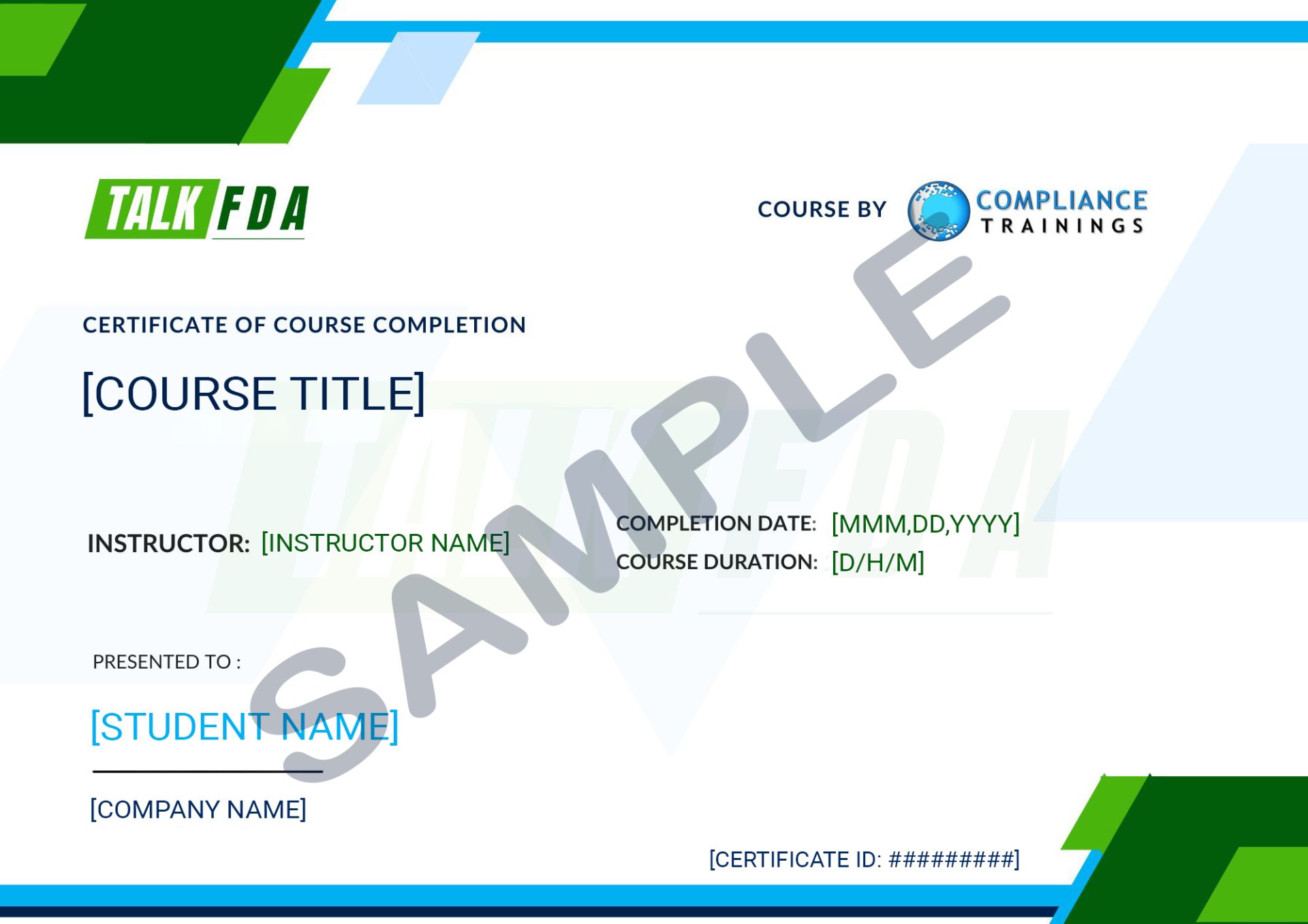
Complete the course and your certificate is unlocked automatically in your learning history.

The challenge with training is rarely signing up. It’s what happens afterward, when access, materials, & certification aren’t accessible from one place.
With TalkFDA Courses, Everything you need Live in One Place.
Simple. Organized. Professional.
Go ahead and Take the Course with confidence.

Our students love us ❤️

“Training was well structured and covered the important areas without unnecessary complexity.”


Coordinator, Laboratory Operations

“Practical examples helped our team better understand laboratory operations procedures.”

Engineer, Quality Systems

“Useful for our current stage. Timing worked out well for us.”


Manager, Research and Development


People who took this Course, also viewed