INSTANT STREAMING COURSE
Share:

How FDA trains its Investigators to Review CAPA and How should you prepare

This course provides a working understanding of how FDA investigators assess CAPA systems, enabling organizations to evaluate internal procedures, strengthen documentation practices, and prepare corrective action records using the same inspection principles applied during FDA facility inspections. This Course is designed for professionals responsible for quality systems, corrective actions, inspection readiness, and compliance documentation.

REGISTER FOR THE COURSE

US $190 per learner

30-Days Unlimited Streaming Access

/* Hide default + / - icon */ .accordion-toggle-icon { opacity: 0; } /* Add circle instead */ .accordion-header::after { content: "○"; font-size: 18px; margin-left: auto; transition: 0.2s ease; } /* When open → filled circle */ .accordion-item.active .accordion-header::after { content: "●"; } /* Hide default + / - icon */ .accordion-toggle-icon { opacity: 0; } /* Add circle instead */ .accordion-header::after { content: "○"; font-size: 18px; margin-left: auto; transition: 0.2s ease; } /* When open → filled circle */ .accordion-item.active .accordion-header::after { content: "●"; } .accordion-header::after { content: "◯"; font-size: 18px; transition: transform 0.25s ease; } .accordion-item.active .accordion-header::after { transform: rotate(90deg); }

REGISTER FOR THE COURSE

To Get 30-Day Access to ONLY this Course 

US $190 per learner
  • This course is Included in Subscription Pack
Subscription include access to entire Learning Library
/* Hide default + / - icon */ .accordion-toggle-icon { opacity: 0; } /* Add circle instead */ .accordion-header::after { content: "○"; font-size: 18px; margin-left: auto; transition: 0.2s ease; } /* When open → filled circle */ .accordion-item.active .accordion-header::after { content: "●"; } /* Hide default + / - icon */ .accordion-toggle-icon { opacity: 0; } /* Add circle instead */ .accordion-header::after { content: "○"; font-size: 18px; margin-left: auto; transition: 0.2s ease; } /* When open → filled circle */ .accordion-item.active .accordion-header::after { content: "●"; } .accordion-header::after { content: "◯"; font-size: 18px; transition: transform 0.25s ease; } .accordion-item.active .accordion-header::after { transform: rotate(90deg); }
  • Faculty
    Charles Paul
  • Duration
    90 Minutes
  • Course ID
    TF3561
  • Ask the Expert
    Included
  • Presentation Handout
    & Templates
  • Assessment
    & Certification Included

About the Course

FDA investigators routinely examine CAPA records in detail because deficiencies within the system often connect directly to inspection findings. Organizations that cannot demonstrate consistent problem identification, corrective action management, and documented follow-through face increased regulatory exposure during inspections. Understanding the investigative approach used by FDA personnel is therefore essential for maintaining an inspection-ready quality system.


The course explains CAPA process steps, common implementation difficulties, and the specific FDA references investigators use when assessing compliance activities. Content drawn from the Investigations Operations Manual, Compliance Program Guidance Manual 7382.845, and the QSIT Manual clarifies inspectional objectives, decision flow expectations, and documentation review practices. Additional discussion addresses medical device reporting, corrections and removals, and tracking requirements connected to CAPA evaluations. Participants gain a practical basis for reviewing internal CAPA activities using the same inspection logic applied during FDA facility inspections. This perspective supports more consistent preparation before regulatory investigators arrive.

  • Interpret CAPA Through FDA Inspection Criteria:

    Reviewing CAPA activities through the structure used by FDA investigators improves internal assessment accuracy and inspection preparation. The course explains how investigators evaluate corrective action records, supporting documentation, and compliance decisions using established FDA manuals. This perspective helps organizations identify procedural weaknesses before they become inspection observations or recurring quality issues.

  • Strengthen CAPA Documentation and Follow-Through:

    CAPA systems frequently fail when problem identification, corrective actions, or verification activities are poorly documented or inconsistently managed. The material connects FDA inspection expectations with practical review methods drawn from the QSIT Manual and Compliance Program Guidance Manual 7382.845. Organizations can better prepare records, justify decisions, and manage ongoing corrective action responsibilities.

Key Areas Covered

  • CAPA definitions, process steps, and corrective action workflow expectations
  • Common CAPA implementation challenges and recurring operational pitfalls
  • FDA investigator review methods for problem identification and corrective action activities
  • Investigations Operations Manual (IOM) requirements and recommended compliance methods
  • Compliance Program Guidance Manual 7382.845 and CAPA inspection considerations
  • QSIT Manual inspectional objectives and CAPA decision flow expectations
  • Medical Device Reporting responsibilities connected to CAPA evaluations
  • Corrections, removals, and medical device tracking considerations during inspections

Who Must Attend

  • Quality Assurance Department
  • Quality Control Department
  • Regulatory Affairs Department
  • Manufacturing Department
  • Executive Management
  • Production Department

Quality training, expert insights, and answers that matter. Know your Expert

CHARLES PAUL

Charles Paul is an instructional designer and management consultant with more than 30 years of experience supporting regulated industries. His work includes implementing quality systems and developing GMP documentation and training programs across pharmaceuticals, biotech, foods and beverage, cosmetics, and OTC consumer products. That background aligns directly with the operational and documentation issues addressed in CAPA inspections, corrective action management, and FDA quality system expectations.

If you would like to request a Proforma invoice to sign up for this course. please click here

Commonly Asked Questions About This Subject

The following questions address practical regulatory, compliance, validation, quality, operational, and inspection-related considerations commonly associated with this subject.

What CAPA weaknesses receive the most attention during FDA inspections?

FDA investigators typically focus on whether CAPA activities demonstrate effective problem identification, appropriate investigation depth, and sustained corrective action. Weaknesses often appear when organizations close CAPAs without sufficient evidence that the underlying issue was understood or controlled.


Inspection concerns frequently develop when root cause analysis is limited to immediate symptoms rather than evaluating process failures, system issues, or contributing factors. Investigators also review whether corrective actions match the significance of the problem and whether effectiveness checks provide meaningful confirmation.


Strong CAPA records show a clear connection between the original issue, investigation findings, selected actions, and follow-up evaluation. Documentation should allow an independent reviewer to understand why decisions were made and how recurrence risk was addressed.


A CAPA system becomes more reliable when records demonstrate disciplined evaluation rather than simply completion of required steps.

How do FDA investigators evaluate whether a CAPA system is operating effectively?

FDA investigators evaluate CAPA effectiveness by reviewing whether the system consistently identifies problems, addresses root causes, and prevents recurrence. They do not rely only on individual CAPA records but also examine trends, repeat issues, quality data, and management oversight.


A frequent area of concern is the disconnect between written procedures and actual execution. Investigators may identify weaknesses when procedures require robust investigation practices, but records show limited analysis, unsupported conclusions, or incomplete verification activities.


Evidence of effective CAPA management includes appropriate escalation decisions, documented rationale, timely completion, and meaningful effectiveness measurements. Investigators look for indications that quality systems are actively controlling risks rather than simply processing records.


Organizations with strong CAPA programs can demonstrate how information moves from problem identification through resolution and ongoing monitoring.

What documentation gaps make CAPA records difficult to evaluate during FDA inspections?

CAPA records become difficult to evaluate when the documentation does not clearly explain how decisions were reached. Investigators need to understand the relationship between the identified problem, investigation activities, root cause conclusions, and corrective actions.


Common documentation issues include unclear investigation scope, insufficient supporting evidence, incomplete rationale for decisions, and effectiveness checks that do not measure the actual problem being addressed. These gaps create uncertainty about whether the CAPA process controlled the underlying risk.


Strong documentation provides a logical record of why actions were selected and how their impact was assessed. Supporting data, review approvals, and consistent decision-making practices help demonstrate control over quality issues.


A well-maintained CAPA record should allow an investigator unfamiliar with the original event to follow the reasoning from initial discovery through final resolution.

How can organizations prepare internal CAPA reviews using the same approach applied by FDA investigators?

Internal CAPA reviews become more effective when they evaluate records from an investigator’s perspective rather than only checking procedural completion. Reviewers should examine whether the problem was properly defined, evidence supports the investigation, and corrective actions address the actual cause.


Practical preparation involves challenging assumptions, reviewing recurring issues, and evaluating whether effectiveness checks demonstrate lasting improvement. CAPAs that appear complete but fail to reduce repeat problems often indicate weaknesses that inspectors may identify.


A strong internal review considers the questions an investigator would ask about risk assessment, decision rationale, supporting evidence, and management involvement. This approach helps identify gaps before they become inspection observations.


Organizations that regularly assess CAPA records through an inspection-focused lens develop stronger consistency, better documentation practices, and greater confidence in their quality system performance.

Ready to Strengthen Your Team? Let’s Build Your Training Plan.

Whether you’re looking for a single onsite workshop or a multi-team training series, we’ll help you design a program that fits your goals, timelines, and operational reality.

Your team deserves the clarity.
Your organization deserves the confidence.

Upcoming Courses

Your TalkFDA Webinar Experience

When you reserve your seat, everything is organized for you — from access to certification from one place.

1. Confirmation

You receive a confirmation email and your course appears instantly in your TalkFDA dashboard.

2. Your Course Hub
Your TalkFDA course page becomes your central hub where you can watch the course, access materials, and manage your learning.

3. Access course materials
The presentation handout and other materials can be downloaded inside the Course Player. You could use Discussion feature there to ask your questions.

4. Watch The Streaming and Complete your Course
The course playback will be available on the same course page. You could pause and continue or you can revisit important sections.
5. Earn Your Certificate
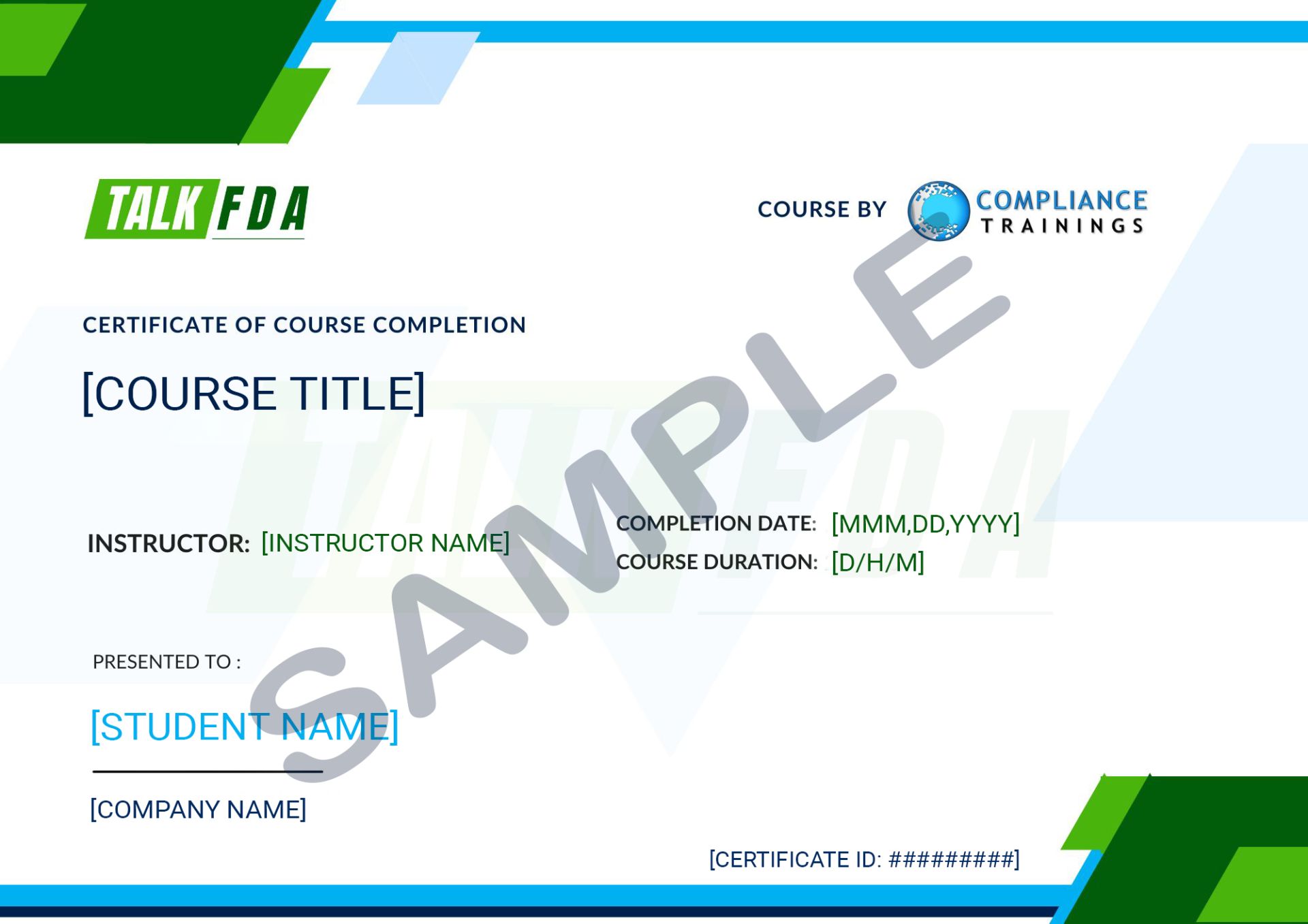
Complete the course and your certificate is unlocked automatically in your learning history.

The challenge with training is rarely signing up. It’s what happens afterward, when access, materials, & certification aren’t accessible from one place.
With TalkFDA Courses, Everything you need Live in One Place.
Simple. Organized. Professional.
Go ahead and Take the Course with confidence.

Our students love us ❤️

“Presenter knew where to spend time and where to move quickly. That made a difference.”

Director, Quality Assurance

“Liked the way concepts were broken down. Not too heavy.”


Executive, Regulatory Affairs

“Content was organized. That made it easier to go back and review internally.”

Lab Manager, Quality Control

People who took this Course, also viewed