INSTANT STREAMING COURSE
Share:

Design Verification and Validation

This course strengthens the ability to connect design inputs with verification and validation evidence, reducing regulatory exposure during FDA and CE submissions. Participants will improve documentation practices, statistical evaluation, and traceability needed to support medical device design control activities. This Course is designed for professionals responsible for medical device design control, validation activities, quality documentation, and compliance.

REGISTER FOR THE COURSE

US $190 per learner

30-Days Unlimited Streaming Access

/* Hide default + / - icon */ .accordion-toggle-icon { opacity: 0; } /* Add circle instead */ .accordion-header::after { content: "○"; font-size: 18px; margin-left: auto; transition: 0.2s ease; } /* When open → filled circle */ .accordion-item.active .accordion-header::after { content: "●"; } /* Hide default + / - icon */ .accordion-toggle-icon { opacity: 0; } /* Add circle instead */ .accordion-header::after { content: "○"; font-size: 18px; margin-left: auto; transition: 0.2s ease; } /* When open → filled circle */ .accordion-item.active .accordion-header::after { content: "●"; } .accordion-header::after { content: "◯"; font-size: 18px; transition: transform 0.25s ease; } .accordion-item.active .accordion-header::after { transform: rotate(90deg); }

REGISTER FOR THE COURSE

To Get 30-Day Access to ONLY this Course 

US $190 per learner
  • This course is Included in Subscription Pack
Subscription include access to entire Learning Library
/* Hide default + / - icon */ .accordion-toggle-icon { opacity: 0; } /* Add circle instead */ .accordion-header::after { content: "○"; font-size: 18px; margin-left: auto; transition: 0.2s ease; } /* When open → filled circle */ .accordion-item.active .accordion-header::after { content: "●"; } /* Hide default + / - icon */ .accordion-toggle-icon { opacity: 0; } /* Add circle instead */ .accordion-header::after { content: "○"; font-size: 18px; margin-left: auto; transition: 0.2s ease; } /* When open → filled circle */ .accordion-item.active .accordion-header::after { content: "●"; } .accordion-header::after { content: "◯"; font-size: 18px; transition: transform 0.25s ease; } .accordion-item.active .accordion-header::after { transform: rotate(90deg); }
  • Faculty
    Alan M. Golden
  • Duration
    90 Minutes
  • Course ID
    TF3595
  • Ask the Expert
    Included
  • Presentation Handout
    & Templates
  • Assessment
    & Certification Included

About the Course

Verification and validation activities are essential for demonstrating that a medical device meets intended design requirements and user expectations. Incomplete design control practices can create significant regulatory concerns during FDA submissions and CE mark reviews, particularly when verification evidence, validation records, or traceability documentation are insufficient. Maintaining clear alignment between design inputs, testing activities, and documented outcomes remains critical throughout product development and quality assurance processes.


The session focuses on the practical application of design verification and validation within regulated medical device environments. The course addresses traceability from inputs through outputs, methods used for verification and validation including statistical approaches, and the preparation of protocols and supporting records. Attention is also given to handling discrepancies, documenting deviations, and developing trace matrices necessary for maintaining complete and inspection-ready design control documentation.

  • Strengthen Design Traceability and Validation Records:

    Medical device organizations must maintain clear evidence linking design inputs to verification and validation outcomes. This course develops practical understanding of trace matrices, protocol preparation, discrepancy handling, and supporting records needed for design control activities. Stronger documentation practices help reduce review deficiencies during FDA inspections and CE mark submission assessments.

  • Apply Verification and Validation Methods with Greater Consistency:

    Verification and validation decisions require documented justification supported by appropriate testing and statistical evaluation. This course clarifies methods used to confirm design requirements and user needs while improving consistency across development activities. Better alignment between validation evidence and documented inputs can reduce operational rework and regulatory questions during product review.

Key Areas Covered

  • Design control flow and placement of verification and validation activities within medical device development
  • Traceability from design inputs through verification and validation outputs
  • Verification and validation methods used to evaluate design inputs
  • Statistical techniques supporting validation activities and documented evidence generation
  • Development of protocols, records, and supporting validation documentation
  • Management of discrepancies and deviations during verification and validation activities
  • Preparation and use of trace matrices linking inputs and outputs
  • Regulatory considerations affecting FDA approval and CE mark submissions for medical devices

Who Must Attend

  • QA/QC Departments
  • Regulatory Affairs Teams
  • Research & Development Professionals
  • Manufacturing, Engineering & Operations
  • Production & Product Support Personnel
  • Medical Device Design, Development & Marketing Professionals

Quality training, expert insights, and answers that matter. Know your Expert

ALAN M. GOLDEN

Alan M. Golden brings extensive experience in medical device research, quality assurance, and regulated product development. During his career at Abbott Laboratories, he worked extensively with design control, validation, change control, CAPA, and risk management activities supporting both new and on-market products. His background includes quality assurance oversight for diagnostics and molecular divisions, along with global training experience focused on verification, validation, statistical applications, and regulated quality system practices.

If you would like to request a Proforma invoice to sign up for this course. please click here

Commonly Asked Questions About This Subject

The following questions address practical regulatory, compliance, validation, quality, operational, and inspection-related considerations commonly associated with this subject.

Why do verification and validation activities often create regulatory questions even when testing has been completed successfully?

Successful testing alone does not always demonstrate that verification and validation activities were properly controlled. Regulatory reviewers often examine whether the testing approach was justified, whether acceptance criteria were appropriate, and whether the results clearly demonstrate that design requirements were met.


A frequent issue appears when teams can show test results but cannot explain why specific methods, sample sizes, conditions, or acceptance limits were selected. Completed protocols and reports may appear adequate until reviewers ask how the evidence supports the original design decisions.


Development teams sometimes underestimate the importance of the connection between requirements and testing strategy. A strong result from an improperly designed test may provide limited confidence because it does not clearly address the intended requirement.


Defensible verification and validation records demonstrate the reasoning behind the approach, not just the final outcome. Clear links between design inputs, test methods, acceptance criteria, and conclusions help reviewers understand why the evidence supports the device design.

When should a failed verification or validation result trigger broader investigation rather than a limited correction?

A failed verification or validation result should receive broader evaluation when the failure suggests that the underlying design assumption may be incorrect. A narrow correction may be appropriate for isolated issues, but broader review becomes necessary when the failure indicates potential impact on related requirements, components, or intended use.


Inspection concerns often arise when teams focus on fixing the immediate test failure without examining why the failure occurred. Reviewers look closely at whether the issue resulted from a test execution problem, an unclear requirement, an inadequate design approach, or an overlooked risk.


A decision to limit investigation should be supported by documented reasoning. Simply repeating a test or adjusting documentation without understanding the cause can weaken confidence in the final evidence.


Strong handling of failures demonstrates that teams evaluated the significance of the result, considered related design elements, and determined the appropriate response based on technical evidence rather than schedule pressure

How do regulators assess whether validation evidence truly represents actual user needs and intended use?

Regulators assess validation evidence by examining whether testing conditions reflect how the device will actually be used. Validation becomes difficult to defend when test environments, participants, use scenarios, or acceptance criteria do not reasonably represent real-world application.


A common review concern occurs when validation activities confirm that a device functions under controlled conditions but provide limited evidence about usability, user interaction, or operational factors that affect performance. Reviewers often ask whether the evidence supports the intended use described in product documentation.


Teams sometimes focus heavily on generating test results while giving less attention to whether the validation approach was appropriate. Strong evidence depends on selecting conditions that challenge the device in ways that reflect expected use and potential risks.


A defensible validation package explains why the selected approach was appropriate, how user expectations were evaluated, and how conclusions were reached. The quality of the validation decision depends on the relevance of the evidence, not simply the volume of testing performed.

What causes traceability gaps between design inputs, verification results, and validation conclusions?

Traceability gaps usually occur when design information changes faster than documentation systems can keep pace. Requirements may be revised, tests may be modified, or validation approaches may evolve without maintaining clear connections between the original design intent and final evidence.


During inspections, reviewers often follow a single requirement through the entire development process. Missing links between inputs, outputs, protocols, results, and conclusions can create questions about whether the device was evaluated against the correct criteria.


Teams sometimes treat trace matrices as administrative records rather than tools for controlling development decisions. A completed matrix has limited value if it does not accurately reflect changes, unresolved issues, or the rationale behind verification and validation activities.


Strong traceability allows an independent reviewer to understand how each requirement was addressed and whether the evidence supports the final design. Accurate, maintained connections between records demonstrate controlled execution and reduce uncertainty during regulatory review.

Ready to Strengthen Your Team? Let’s Build Your Training Plan.

Whether you’re looking for a single onsite workshop or a multi-team training series, we’ll help you design a program that fits your goals, timelines, and operational reality.

Your team deserves the clarity.
Your organization deserves the confidence.

Upcoming Courses

Your TalkFDA Webinar Experience

When you reserve your seat, everything is organized for you — from access to certification from one place.

1. Confirmation

You receive a confirmation email and your course appears instantly in your TalkFDA dashboard.

2. Your Course Hub
Your TalkFDA course page becomes your central hub where you can watch the course, access materials, and manage your learning.

3. Access course materials
The presentation handout and other materials can be downloaded inside the Course Player. You could use Discussion feature there to ask your questions.

4. Watch The Streaming and Complete your Course
The course playback will be available on the same course page. You could pause and continue or you can revisit important sections.
5. Earn Your Certificate
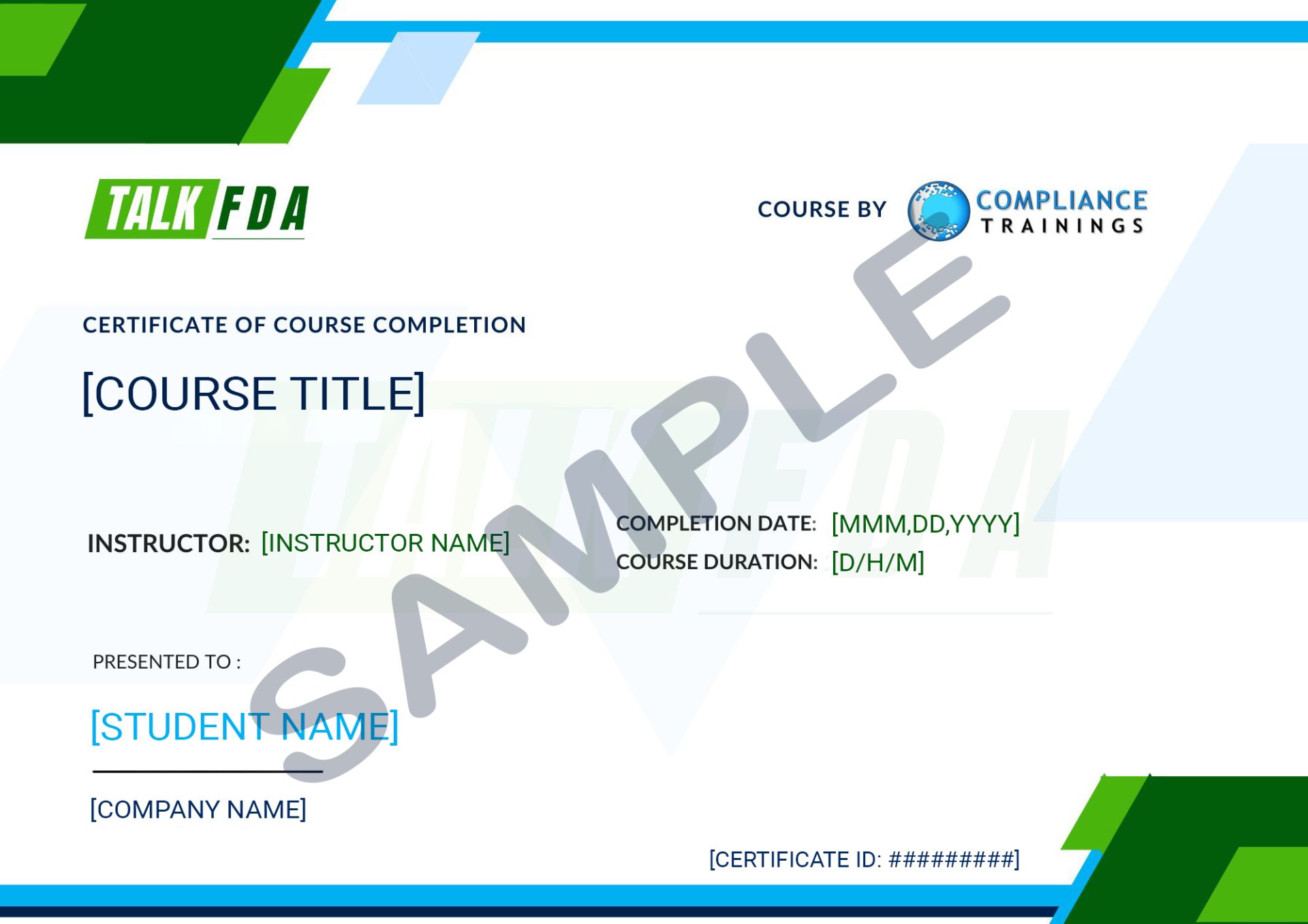
Complete the course and your certificate is unlocked automatically in your learning history.

The challenge with training is rarely signing up. It’s what happens afterward, when access, materials, & certification aren’t accessible from one place.
With TalkFDA Courses, Everything you need Live in One Place.
Simple. Organized. Professional.
Go ahead and Take the Course with confidence.

Our students love us ❤️

“Team appreciated the clarity. Especially on a few areas we were unsure about.”

Vice President, Quality Assurance

“Practical side was covered well. Not just theory.”


Engineer, Validation

“Content was organised. That made it easier to go back and review internally.”

Lab Manager, Quality Control

People who took this Course, also viewed