INSTANT STREAMING COURSE
Share:

Data Integrity by Design, Pharma 4.0 and Overcoming DI issues in the Cloud

This course equips professionals to strengthen data integrity controls across computerized and cloud-based pharmaceutical systems while supporting Pharma 4.0 initiatives. Participants will gain practical direction for reducing compliance exposure, improving data reliability, and aligning digital operations with FDA inspection expectations. This Course is designed for professionals responsible for computerized systems, digital quality operations, data governance, and compliance oversight.

REGISTER FOR THE COURSE

US $190 per learner

30-Days Unlimited Streaming Access

/* Hide default + / - icon */ .accordion-toggle-icon { opacity: 0; } /* Add circle instead */ .accordion-header::after { content: "○"; font-size: 18px; margin-left: auto; transition: 0.2s ease; } /* When open → filled circle */ .accordion-item.active .accordion-header::after { content: "●"; } /* Hide default + / - icon */ .accordion-toggle-icon { opacity: 0; } /* Add circle instead */ .accordion-header::after { content: "○"; font-size: 18px; margin-left: auto; transition: 0.2s ease; } /* When open → filled circle */ .accordion-item.active .accordion-header::after { content: "●"; } .accordion-header::after { content: "◯"; font-size: 18px; transition: transform 0.25s ease; } .accordion-item.active .accordion-header::after { transform: rotate(90deg); }

REGISTER FOR THE COURSE

To Get 30-Day Access to ONLY this Course 

US $190 per learner
  • This course is Included in Subscription Pack
Subscription include access to entire Learning Library
/* Hide default + / - icon */ .accordion-toggle-icon { opacity: 0; } /* Add circle instead */ .accordion-header::after { content: "○"; font-size: 18px; margin-left: auto; transition: 0.2s ease; } /* When open → filled circle */ .accordion-item.active .accordion-header::after { content: "●"; } /* Hide default + / - icon */ .accordion-toggle-icon { opacity: 0; } /* Add circle instead */ .accordion-header::after { content: "○"; font-size: 18px; margin-left: auto; transition: 0.2s ease; } /* When open → filled circle */ .accordion-item.active .accordion-header::after { content: "●"; } .accordion-header::after { content: "◯"; font-size: 18px; transition: transform 0.25s ease; } .accordion-item.active .accordion-header::after { transform: rotate(90deg); }
  • Faculty
    Carolyn Troiano
  • Duration
    75 Minutes
  • Course ID
    TF3542
  • Ask the Expert
    Included
  • Presentation Handout
    & Templates
  • Assessment
    & Certification Included

About the Course

Data integrity has become a critical operational requirement as pharmaceutical organizations increase dependence on computerized systems, automation, artificial intelligence, and cloud-based environments. Effective control of data across system and process lifecycles directly affects product quality, patient safety, regulatory compliance, and inspection readiness. FDA inspection trends continue to place significant focus on the reliability, traceability, and management of electronic data within regulated operations.


A structured Data Integrity by Design approach supports the integration of data governance into business processes from initial planning through system retirement. This is particularly important for organizations advancing toward Pharma 4.0 models that depend on connected systems, advanced process control, and integrated laboratory software environments. The course addresses practical considerations related to computer system validation, digital transformation, and cloud computing challenges while connecting these issues to operational productivity, quality improvement, and long-term management of regulated electronic data systems.

  • Managing Data Integrity Across Pharma 4.0 Operations:

    Participants will gain a clearer understanding of how data integrity principles apply throughout computerized system lifecycles, including planning, implementation, operation, and retirement. The course connects these controls to Pharma 4.0 initiatives involving automation, AI, machine learning, and integrated laboratory systems, helping organizations reduce operational inconsistencies and strengthen inspection readiness as digital infrastructures expand.

  • Addressing Cloud-Based Compliance and Validation Risks:

    The course provides practical direction for evaluating cloud-related data integrity concerns alongside computer system validation responsibilities. Participants will better understand how FDA inspection trends influence expectations for electronic records, data governance, and controlled digital processes. This knowledge supports more informed decisions when managing cloud environments, productivity improvements, and evolving digital transformation initiatives within regulated operations.

Key Areas Covered

  • Data Integrity by Design principles across business process and system lifecycles
  • FDA inspection trends related to electronic data management and integrity controls
  • Computer System Validation (CSV) considerations for regulated computerized systems
  • Pharma 4.0 concepts, operational models, and integrated digital environments
  • Data management challenges involving automation, AI, and machine learning systems
  • Productivity and quality improvements through connected laboratory software systems
  • Data integrity risks and operational concerns associated with cloud computing
  • Practical approaches for overcoming cloud-based DI issues during digital transformation

Who Must Attend

  • IT & Software Professionals
  • QA/QC & Laboratory Teams
  • Compliance, Audit & Risk Professionals
  • Manufacturing, Automation & Supply Chain Teams
  • Regulatory & Clinical Data Specialists
  • CSV & GMP Training Professionals
  • Business Stakeholders & Testers
  • Life Sciences Vendors & Consultants

Quality training, expert insights, and answers that matter. Know your Expert

CAROLYN TROIANO

Carolyn Troiano has more than 30 years of experience in computer system validation within pharmaceutical, medical device, tobacco, animal health, and other FDA-regulated industries. She has advised organizations on large-scale IT implementation projects and validation strategies since the early development of FDA guidance in this area. Carolyn also collaborated with FDA and industry representatives on 21 CFR Part 11, providing direct experience relevant to electronic records, computerized systems, and data integrity management in regulated environments.

If you would like to request a Proforma invoice to sign up for this course. please click here

Commonly Asked Questions About This Subject

The following questions address practical regulatory, compliance, validation, quality, operational, and inspection-related considerations commonly associated with this subject.

How should data integrity risks be prioritized when multiple computerized systems contain known deficiencies?

Risk should be prioritized according to the potential impact on product quality, patient safety, and regulated decision making rather than the age or complexity of the system. A documented rationale explaining why one issue was addressed before another is generally easier to defend than attempting to remediate every deficiency simultaneously.


Inspection discussions often focus on deferred remediation activities. Open issues become difficult to justify when records do not explain the associated risk, the interim controls in place, or the criteria used to determine that continued operation remained acceptable.


Supporting documentation should connect technical findings with quality risk assessments, business impact, and management decisions. System criticality, data usage, process dependencies, and available compensating controls all strengthen prioritization when they are evaluated using consistent criteria.


Well governed remediation reflects disciplined risk management instead of resource limitations. Inspectors are usually more interested in the documented reasoning behind deferred actions than the number of issues that were ultimately resolved.

Why do well validated computerized systems still receive data integrity inspection observations?

Successful validation demonstrates that a system performed as intended when it was evaluated. It does not demonstrate that the system continues to produce reliable, attributable, and complete data throughout routine operation. Inspectors frequently distinguish between validated functionality and controlled operational use.


Inspection observations often arise because user access, audit trail review, procedural controls, exception handling, or change management gradually diverge from the conditions established during validation. The system itself may continue to function correctly while operational practices weaken the reliability of regulated data.


Documentation should demonstrate that ongoing governance remains aligned with validated system behavior. Periodic reviews, controlled configuration changes, access management records, and evidence that critical data are routinely monitored provide stronger support than relying solely on historical validation documentation.


Validation establishes confidence at a point in time. Continued operational oversight demonstrates that confidence remains justified throughout the system lifecycle.

How should data integrity be defended when cloud service providers control portions of the technical environment?

Responsibility for regulated data remains with the regulated organization, even when infrastructure, hosting, or platform management is performed by a cloud provider. Inspection readiness depends on demonstrating effective oversight rather than direct technical ownership of every system component.


Cloud environments often divide operational responsibilities between internal teams and external providers. Unclear accountability for security events, audit trail retention, backup activities, system changes, or incident response can weaken otherwise acceptable controls when those responsibilities are not fully documented.


Oversight should be supported by supplier qualification records, quality agreements, defined service responsibilities, periodic performance reviews, and evidence that provider activities continue to satisfy regulated expectations. Documentation should clearly identify which controls are managed internally and which rely on contractual obligations.


Effective governance depends on visibility into outsourced activities. Confidence in a cloud environment is strengthened by documented oversight rather than assumptions about vendor compliance.

What evidence carries the most weight when demonstrating that data integrity controls remain effective after implementation?

Evidence showing consistent operational performance over time generally carries greater weight than records confirming that controls were implemented during deployment. Inspectors often look for proof that data remain reliable during routine use rather than evidence that a project was completed successfully.


Periodic audit trail reviews, access monitoring, exception trending, backup verification, change control records, and internal assessments provide stronger support when they demonstrate that critical controls continue to operate as intended. Those activities help confirm that data integrity is actively maintained instead of assumed.


The selected evidence should relate directly to the risks the controls were designed to reduce. Metrics that cannot be connected to specific data integrity objectives provide limited support when inspection questions focus on the reliability and traceability of regulated records.


Data integrity is demonstrated through sustained control supported by objective evidence. Long term operational performance provides stronger assurance than implementation records alone.

Ready to Strengthen Your Team? Let’s Build Your Training Plan.

Whether you’re looking for a single onsite workshop or a multi-team training series, we’ll help you design a program that fits your goals, timelines, and operational reality.

Your team deserves the clarity.
Your organization deserves the confidence.

Upcoming Courses

Your TalkFDA Webinar Experience

When you reserve your seat, everything is organized for you — from access to certification from one place.

1. Confirmation

You receive a confirmation email and your course appears instantly in your TalkFDA dashboard.

2. Your Course Hub
Your TalkFDA course page becomes your central hub where you can watch the course, access materials, and manage your learning.

3. Access course materials
The presentation handout and other materials can be downloaded inside the Course Player. You could use Discussion feature there to ask your questions.

4. Watch The Streaming and Complete your Course
The course playback will be available on the same course page. You could pause and continue or you can revisit important sections.
5. Earn Your Certificate
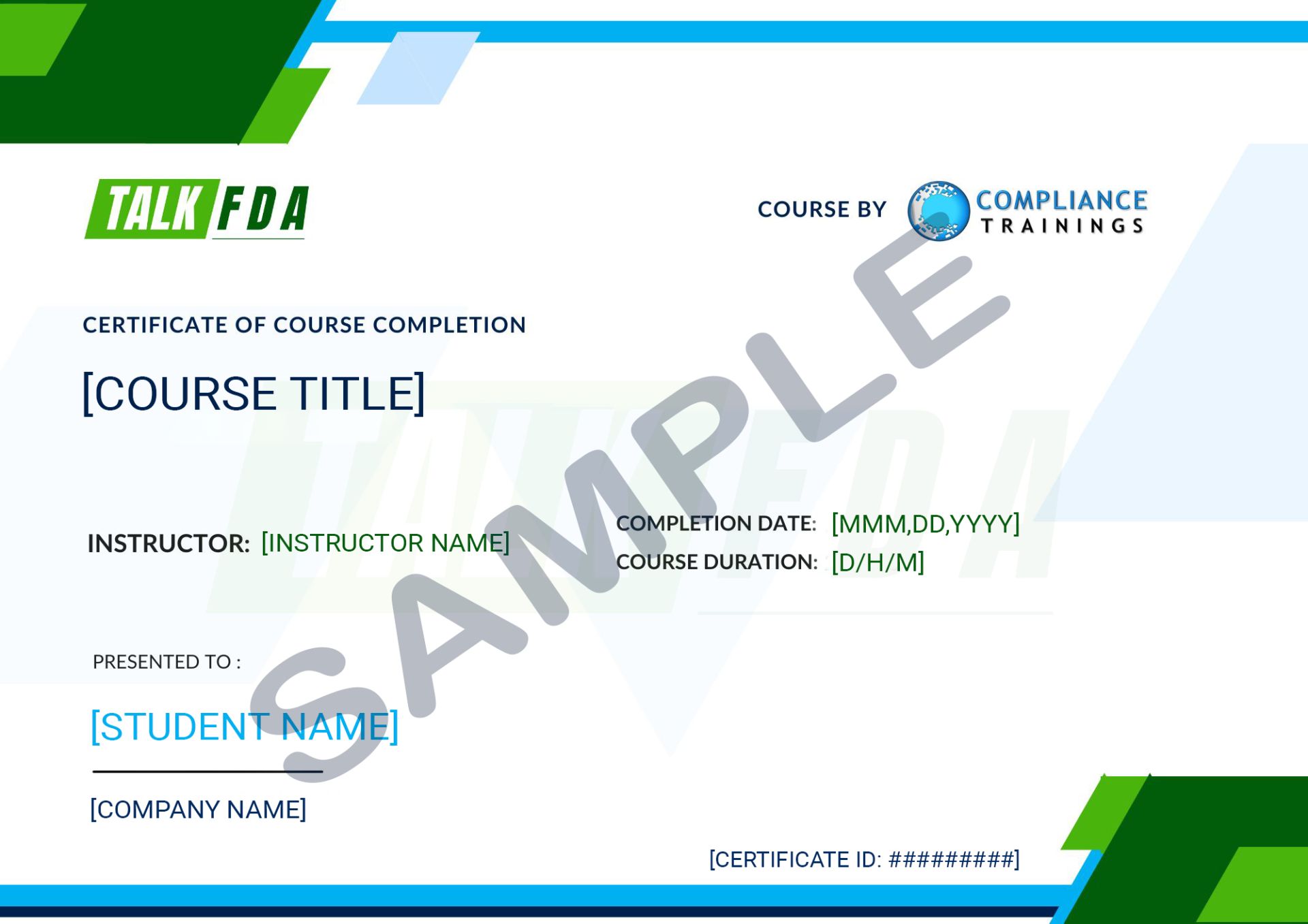
Complete the course and your certificate is unlocked automatically in your learning history.

The challenge with training is rarely signing up. It’s what happens afterward, when access, materials, & certification aren’t accessible from one place.
With TalkFDA Courses, Everything you need Live in One Place.
Simple. Organized. Professional.
Go ahead and Take the Course with confidence.

Our students love us ❤️

“Presenter didn’t overcomplicate things. Kept it moving. That helped keep the team engaged.”

Director, Manufacturing

“Liked the way concepts were broken down. Not too heavy.”


Engineer, Engineering

“Would consider similar sessions again. Format worked for us.”


Director, Regulatory Affairs

People who took this Course, also viewed