INSTANT STREAMING COURSE
Share:

Avoid Warning Letters in View of the U.S. FDA's Stated Goal

This course strengthens your ability to identify compliance gaps before inspections escalate into enforcement actions. It provides practical direction for managing FDA expectations, focusing internal resources, and reducing recurring quality and regulatory exposure tied to cGMP oversight. This Course is designed for professionals responsible for regulatory compliance, quality oversight, inspection preparation, and operational risk control.

REGISTER FOR THE COURSE

US $190 per learner

30-Days Unlimited Streaming Access

/* Hide default + / - icon */ .accordion-toggle-icon { opacity: 0; } /* Add circle instead */ .accordion-header::after { content: "○"; font-size: 18px; margin-left: auto; transition: 0.2s ease; } /* When open → filled circle */ .accordion-item.active .accordion-header::after { content: "●"; } /* Hide default + / - icon */ .accordion-toggle-icon { opacity: 0; } /* Add circle instead */ .accordion-header::after { content: "○"; font-size: 18px; margin-left: auto; transition: 0.2s ease; } /* When open → filled circle */ .accordion-item.active .accordion-header::after { content: "●"; } .accordion-header::after { content: "◯"; font-size: 18px; transition: transform 0.25s ease; } .accordion-item.active .accordion-header::after { transform: rotate(90deg); }

REGISTER FOR THE COURSE

To Get 30-Day Access to ONLY this Course 

US $190 per learner
  • This course is Included in Subscription Pack
Subscription include access to entire Learning Library
/* Hide default + / - icon */ .accordion-toggle-icon { opacity: 0; } /* Add circle instead */ .accordion-header::after { content: "○"; font-size: 18px; margin-left: auto; transition: 0.2s ease; } /* When open → filled circle */ .accordion-item.active .accordion-header::after { content: "●"; } /* Hide default + / - icon */ .accordion-toggle-icon { opacity: 0; } /* Add circle instead */ .accordion-header::after { content: "○"; font-size: 18px; margin-left: auto; transition: 0.2s ease; } /* When open → filled circle */ .accordion-item.active .accordion-header::after { content: "●"; } .accordion-header::after { content: "◯"; font-size: 18px; transition: transform 0.25s ease; } .accordion-item.active .accordion-header::after { transform: rotate(90deg); }
  • Faculty
    John E. Lincoln‎
  • Duration
    90 Minutes
  • Course ID
    TF1653
  • Ask the Expert
    Included
  • Presentation Handout
    & Templates
  • Assessment
    & Certification Included

About the Course

U.S. FDA inspection activity continues to place greater emphasis on enforcement readiness, documentation accuracy, and consistent compliance with applicable cGMP requirements. Organizations operating with limited personnel, competing priorities, or unresolved quality system weaknesses face increased exposure during inspections when critical issues are overlooked or improperly addressed. Understanding current FDA inspectional objectives and recent enforcement patterns has become essential for maintaining operational control and avoiding regulatory escalation.


This webinar addresses the practical areas most frequently associated with warning letters, including recurring inspection findings, ineffective compliance preparation, and gaps identified during internal reviews. The course outlines methods for conducting proactive assessments of applicable FDA and cGMP expectations while directing resources toward higher-risk operational areas. Participants will gain current insight into FDA implementation priorities, common compliance failures, audit preparation concerns, and the operational impact of unresolved quality and regulatory deficiencies.

  • Strengthen Inspection Readiness and Compliance Oversight:

    Organizations facing FDA inspections must demonstrate consistent control over quality systems, documentation practices, and regulatory responsibilities. This course provides practical insight into inspectional objectives, common compliance breakdowns, and recurring enforcement trends that often trigger warning letters. Participants will be better prepared to evaluate internal weaknesses before they become significant regulatory observations or corrective action burdens.

  • Improve Resource Prioritization for Higher-Risk Areas:

    Many companies struggle to allocate limited compliance and quality resources across expanding regulatory expectations. This course clarifies where attention should be directed during internal reviews, compliance audits, and preparation activities tied to FDA oversight. Participants will gain a clearer understanding of operational areas commonly associated with critical mistakes, unresolved findings, and increased regulatory scrutiny.

Key Areas Covered

  • U.S. FDA enforcement priorities and current implementation focus areas
  • Proactive evaluation of applicable U.S. FDA and cGMP requirements
  • Methods for directing limited compliance resources toward higher-risk operations
  • FDA inspectional objectives and expectations during regulatory reviews
  • Common operational and documentation mistakes linked to non-compliance findings
  • Recent inspection trends, enforcement events, and recurring compliance concerns
  • Internal compliance audit preparation and assessment considerations
  • Interactive Q&A addressing regulatory and inspection-related challenges

Who Must Attend

  • QA/QC Departments
  • Research and Development Team
  • Manufacturing Departments
  • Regulatory Affairs Departments
  • Operations Departments
  • Internal and Supplier Auditors
If you would like to request a Proforma invoice to sign up for this course. please click here

Quality training, expert insights, and answers that matter. Know your Expert

JOHN E. LINCOLN

John E. Lincoln is Principal of J. E. Lincoln and Associates LLC with more than 36 years of experience in U.S. FDA-regulated industries, including 22 years as an independent consultant. His work has focused on quality assurance, regulatory affairs, QMS remediation, FDA responses, CAPA systems, validation activities, and risk management. He has supported companies ranging from start-ups to Fortune 100 organizations across multiple countries and has conducted workshops and webinars on FDA audits, compliance systems, and root cause analysis.

Commonly Asked Questions About This Subject

The following questions address practical regulatory, compliance, validation, quality, operational, and inspection-related considerations commonly associated with this subject.

When does an FDA inspection observation indicate a systemic quality system failure rather than an isolated compliance issue?

FDA investigators generally view an observation as systemic when objective evidence shows the same underlying control weakness extends beyond the original event. A single deficiency is seldom evaluated in isolation if related records, processes, or historical trends point to broader quality system shortcomings.


Inspectors look for patterns that connect seemingly unrelated issues. Similar root causes appearing in deviations, complaints, audit findings, validation activities, or change controls often suggest that corrective actions addressed individual events without correcting the broader quality system.


Organizations often weaken their position by assuming an issue is isolated without demonstrating why. If related products, equipment, procedures, or manufacturing periods were excluded from review, the investigation should clearly explain the basis for those decisions and document the supporting evidence.


Defending an observation as isolated requires more than a conclusion. Trend analyses, evaluations of comparable operations, and documented justification for the investigation boundaries provide stronger evidence that the organization understood the potential scope before closing the issue.

How do FDA investigators evaluate whether management exercised adequate oversight before compliance problems emerged?

FDA investigators evaluate management oversight by examining whether leadership recognized developing compliance risks and acted before those risks became inspection findings. Management responsibility is measured through documented decisions rather than organizational charts or approval signatures.


Management review records, quality metrics, escalation reports, audit findings, and resource allocation decisions often reveal whether emerging issues received appropriate attention. Investigators frequently compare what leadership knew with the actions that followed over time.


Inspection discussions become more difficult when recurring deviations, overdue corrective actions, or increasing quality backlogs continue appearing in management reviews without meaningful intervention. Those records may suggest that known risks were accepted rather than effectively managed.


Strong oversight is supported by evidence that management challenged assumptions, requested additional investigation when appropriate, prioritized resources according to risk, and verified that corrective actions achieved sustained improvement. Those activities demonstrate active governance rather than routine administrative review.

When should the scope of an internal investigation be expanded beyond the original observation?

The scope of an investigation should expand when new evidence indicates the original event may represent a broader quality concern. Shared equipment, common suppliers, repeated laboratory results, similar deviations, or related process failures often justify extending the review beyond the initial observation.


Inspectors pay close attention to how organizations determine investigation boundaries. They expect the scope to evolve as additional facts become available rather than remain fixed because of the original problem statement or planned timeline.


Expanding an investigation does not require reviewing every historical record. It requires a documented rationale explaining why certain products, batches, systems, or time periods were included, and why others were reasonably excluded based on available evidence.


Investigations that remain narrowly focused despite contradictory findings often require significant rework during regulatory inspections. A well-supported expansion demonstrates that decisions were driven by objective evidence instead of a desire to complete the investigation quickly.

What makes a scientific or technical justification defensible when FDA expectations are not explicitly defined?

A scientific or technical justification is defensible when another qualified reviewer can independently understand the reasoning and reasonably reach the same conclusion. Data alone seldom accomplishes that without a documented explanation of how the evidence was evaluated.


Inspectors examine the reasoning process as carefully as the outcome. They expect records to explain the assumptions made, the alternatives considered, the uncertainties evaluated, and the basis for accepting one conclusion over another.


Scientific justifications often become difficult to defend when similar situations are evaluated differently across investigations, validations, change controls, or risk assessments. Inconsistent reasoning raises questions about whether decisions were based on evidence or operational convenience.


Well-supported justifications combine objective data, established scientific principles, documented risk evaluation, and a logical decision pathway. Consistency across quality records strengthens credibility because it demonstrates that technical judgment is governed by a disciplined evaluation process rather than individual preference.

Ready to Strengthen Your Team? Let’s Build Your Training Plan.

Whether you’re looking for a single onsite workshop or a multi-team training series, we’ll help you design a program that fits your goals, timelines, and operational reality.

Your team deserves the clarity.
Your organization deserves the confidence.

Upcoming Courses

Your TalkFDA Webinar Experience

When you reserve your seat, everything is organized for you — from access to certification from one place.

1. Confirmation

You receive a confirmation email and your course appears instantly in your TalkFDA dashboard.

2. Your Course Hub
Your TalkFDA course page becomes your central hub where you can watch the course, access materials, and manage your learning.

3. Access course materials
The presentation handout and other materials can be downloaded inside the Course Player. You could use Discussion feature there to ask your questions.

4. Watch The Streaming and Complete your Course
The course playback will be available on the same course page. You could pause and continue or you can revisit important sections.
5. Earn Your Certificate
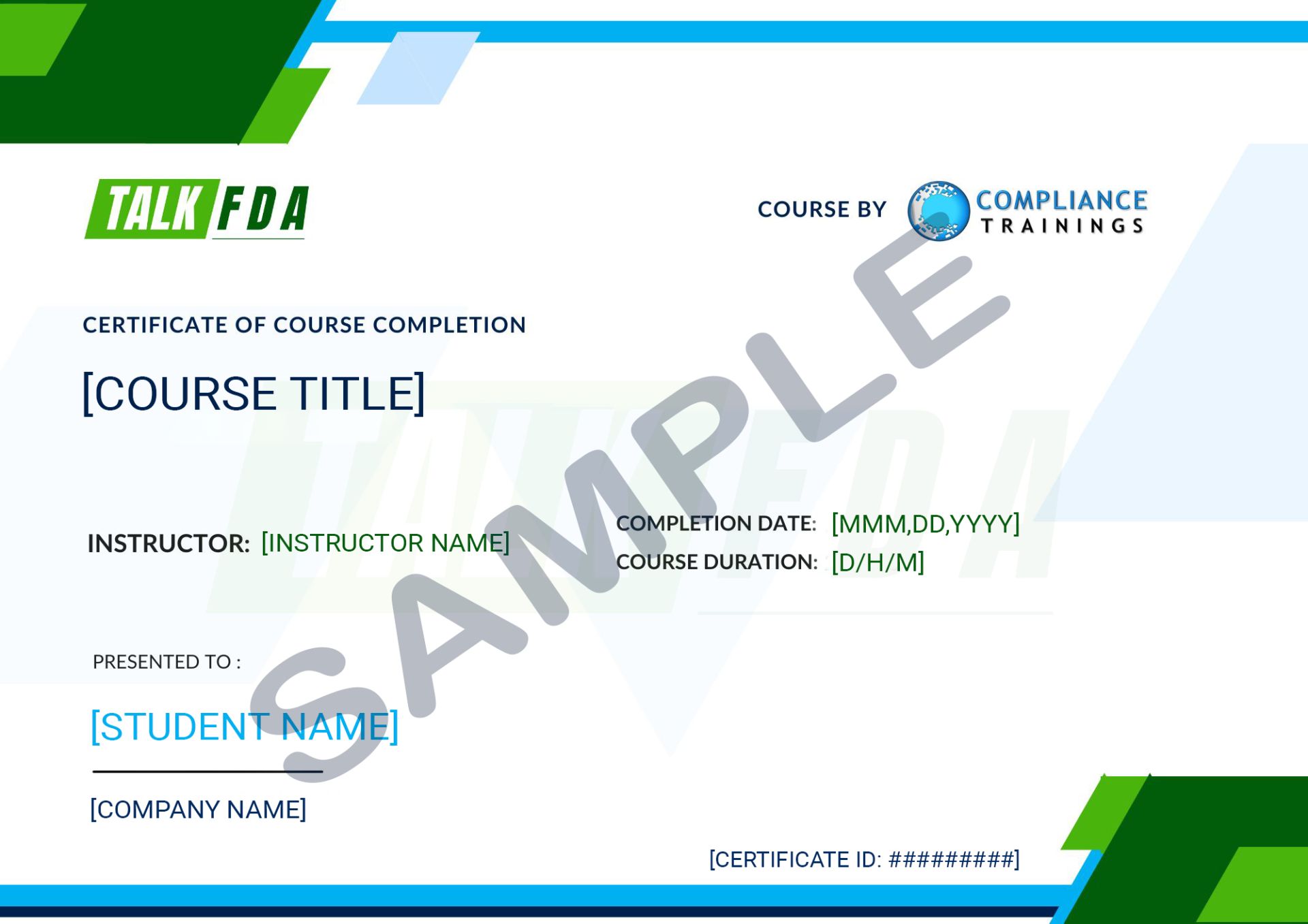
Complete the course and your certificate is unlocked automatically in your learning history.

The challenge with training is rarely signing up. It’s what happens afterward, when access, materials, & certification aren’t accessible from one place.
With TalkFDA Courses, Everything you need Live in One Place.
Simple. Organized. Professional.
Go ahead and Take the Course with confidence.

Our students love us ❤️

“The session helped reinforce areas we sometimes overlook during routine processes. Easy to follow and directly related to current expectations.”

Regulatory Affairs Manager

“Useful perspective on where companies tend to run into trouble during FDA reviews. The content stayed focused and applicable.”

Lead, Research and Development

“The pacing worked well and the information was organized logically. Helpful session for teams involved in quality and operational oversight.”

Director, Quality Systems

People who took this Course, also viewed