INSTANT STREAMING COURSE
Share:

Auditing Computer Systems for Part 11 and International Compliance

This course equips regulated industry professionals to evaluate computer systems, electronic records, and signatures against FDA and international compliance expectations while reducing validation gaps, audit exposure, and data integrity risks across the system life cycle. This Course is designed for professionals managing regulated computerized systems, validation activities, compliance oversight, data integrity, and operational controls.

REGISTER FOR THE COURSE

US $190 per learner

30-Days Unlimited Streaming Access

/* Hide default + / - icon */ .accordion-toggle-icon { opacity: 0; } /* Add circle instead */ .accordion-header::after { content: "○"; font-size: 18px; margin-left: auto; transition: 0.2s ease; } /* When open → filled circle */ .accordion-item.active .accordion-header::after { content: "●"; } /* Hide default + / - icon */ .accordion-toggle-icon { opacity: 0; } /* Add circle instead */ .accordion-header::after { content: "○"; font-size: 18px; margin-left: auto; transition: 0.2s ease; } /* When open → filled circle */ .accordion-item.active .accordion-header::after { content: "●"; } .accordion-header::after { content: "◯"; font-size: 18px; transition: transform 0.25s ease; } .accordion-item.active .accordion-header::after { transform: rotate(90deg); }

REGISTER FOR THE COURSE

To Get 30-Day Access to ONLY this Course 

US $190 per learner
  • This course is Included in Subscription Pack
Subscription include access to entire Learning Library
/* Hide default + / - icon */ .accordion-toggle-icon { opacity: 0; } /* Add circle instead */ .accordion-header::after { content: "○"; font-size: 18px; margin-left: auto; transition: 0.2s ease; } /* When open → filled circle */ .accordion-item.active .accordion-header::after { content: "●"; } /* Hide default + / - icon */ .accordion-toggle-icon { opacity: 0; } /* Add circle instead */ .accordion-header::after { content: "○"; font-size: 18px; margin-left: auto; transition: 0.2s ease; } /* When open → filled circle */ .accordion-item.active .accordion-header::after { content: "●"; } .accordion-header::after { content: "◯"; font-size: 18px; transition: transform 0.25s ease; } .accordion-item.active .accordion-header::after { transform: rotate(90deg); }
  • Faculty
    Carolyn Troiano
  • Duration
    90 Minutes
  • Course ID
    TF3546
  • Ask the Expert
    Included
  • Presentation Handout
    & Templates
  • Assessment
    & Certification Included

About the Course

Computerized systems supporting FDA-regulated activities must remain validated throughout their operational life cycle while maintaining reliable control over electronic records and electronic signatures. Regulatory expectations under 21 CFR Part 11, Annex 11, and GDPR continue to affect how organizations implement, document, secure, review, and maintain systems used across research, manufacturing, laboratories, quality operations, clinical environments, and post-market activities across regulated organizations.


Organizations using paperless or partially electronic processes face increasing scrutiny around user access, password management, signature attribution, segregation of duties, audit readiness, and long-term data integrity assurance. System implementation decisions intended to improve efficiency can also introduce additional oversight burdens if validation practices, documentation controls, and maintenance procedures are not clearly defined. Effective auditing of computerized systems requires a practical understanding of current compliance expectations, inspection observations, validation methodologies, and operational responsibilities tied to electronic record and signature functionality.

  • Strengthen Audit and Inspection Readiness:

    Organizations operating validated systems must demonstrate consistent control over electronic records, signatures, user access, and documented validation activities. This course clarifies common inspection deficiencies, current expectations tied to computerized systems, and practical actions that reduce unnecessary audit delays, compliance observations, and operational disruption during regulatory review.

  • Improve Validation Oversight Across System Life Cycles:

    Computer system validation requires ongoing coordination between technical, quality, and operational functions as systems evolve. Participants gain practical insight into SDLC support for validation, validated-state maintenance, documentation practices, and data integrity controls for both structured and unstructured records as regulatory expectations and technologies continue changing.

Key Areas Covered

  • 21 CFR Part 11 and Annex 11 requirements for electronic records, electronic signatures, and validated systems
  • GDPR expectations affecting computerized systems and regulated data management practices
  • System Development Life Cycle methodologies supporting computer system validation activities
  • Documentation practices required to maintain systems in a validated operational state
  • Data integrity assurance for structured databases, documents, images, and electronic signatures
  • Regulatory audit participation practices, inspection observations, warning letter trends, and risk reduction measures
  • Electronic signature controls, user authentication requirements, and segregation of duties expectations
  • Current validation trends, emerging best practices, and operational impacts of evolving regulatory oversight

Who Must Attend

  • Information Technology Departments
  • QA/QC Departments
  • Audit Departments
  • Computer System Validation Departments
  • Compliance Professionals
  • Laboratory Operations Departments

Quality training, expert insights, and answers that matter. Know your Expert

CAROLYN TROIANA

Carolyn Troiano has more than 30 years of experience supporting computer system validation initiatives within pharmaceutical, medical device, animal health, tobacco, and other FDA-regulated industries. Her background includes developing validation strategies since the 1980s, advising organizations on large-scale IT system implementation projects, and collaborating with FDA and industry representatives on 21 CFR Part 11. Her consulting work focuses on maintaining validated systems, regulatory compliance practices, and electronic record and signature requirements relevant to computerized system audits.

If you would like to request a Proforma invoice to sign up for this course. please click here

Commonly Asked Questions About This Subject

The following questions address practical regulatory, compliance, validation, quality, operational, and inspection-related considerations commonly associated with this subject.

How should auditors evaluate vendor supplied validation documentation without assuming it is sufficient for regulatory compliance?

Vendor documentation can support validation, but it cannot demonstrate that a computerized system is fit for its intended use within your regulated environment. Auditors should expect to see evidence showing how the organization evaluated and supplemented supplier documentation instead of simply accepting it.


A vendor test script that verifies generic functionality carries limited value if critical business processes, system configurations, interfaces, and security controls were never assessed under actual operating conditions. Validation should reflect how the system is used in practice.


Inspection concerns often arise when qualification activities focus on collecting supplier documents rather than documenting independent review and risk based decisions. Auditors look for traceability between requirements, testing, deviations, approvals, and implementation decisions.


Strong validation packages explain why vendor evidence was accepted, where additional verification was necessary, and who approved those decisions. That documentation demonstrates ownership of the validated state instead of reliance on supplier assurances.

What makes user access management one of the most difficult areas to defend during a computerized system audit?

User access management often exposes weaknesses in governance rather than isolated administrative errors. An auditor may find correctly configured accounts while discovering inconsistent approvals, outdated role assignments, or incomplete periodic access reviews.


Evidence becomes far more persuasive when access decisions are linked to documented job responsibilities, approved through defined workflows, and reviewed after personnel or organizational changes. Records should support every significant access decision.


Temporary privileges, shared administrator accounts, inactive users, and delayed account removal following employee departures frequently receive close inspection. These issues suggest that access controls are not operating consistently over time.


Well controlled access management demonstrates repeatable governance supported by documented evidence. Auditors place greater confidence in a process that consistently produces reliable records than in explanations offered during an inspection.

When does change control become a threat to maintaining a validated state instead of simply documenting system updates?

Small technical changes often receive less scrutiny than major upgrades, yet they can introduce validation gaps that become visible during an audit. Configuration changes, software patches, interface updates, or revised reports may all affect intended system performance.


Auditors focus on whether the organization evaluated the potential impact before implementation rather than whether the change eventually caused a problem. The documented assessment often receives as much attention as the testing itself.


Change records should explain why the selected level of assessment, testing, and approval was appropriate for the specific modification. Generic risk classifications without supporting justification are difficult to defend during inspection.


Inspectors also compare approved changes with implementation records and production activities to identify undocumented work. Maintaining a validated state depends on disciplined decision making throughout the change process, not simply completing required forms.

What evidence best demonstrates that audit trails are actively reviewed rather than simply enabled?

An enabled audit trail does not, by itself, demonstrate effective oversight. Auditors expect documented procedures identifying which events require review, who performs those reviews, and how unusual activity is investigated and resolved.


Inspection discussions often extend beyond technical capability into operational execution. Personnel should be able to explain how audit trail reviews support routine oversight and what actions are taken when exceptions are identified.


Review records become more credible when they show examination of events such as deleted records, privilege changes, failed login attempts, or unexpected data modifications. Those records should also document the outcome of any investigation.


Audit trails provide meaningful compliance evidence only when they support decisions that can be reconstructed long after the original activity occurred. A documented review process carries substantially more weight than simply demonstrating that logging was enabled.

Ready to Strengthen Your Team? Let’s Build Your Training Plan.

Whether you’re looking for a single onsite workshop or a multi-team training series, we’ll help you design a program that fits your goals, timelines, and operational reality.

Your team deserves the clarity.
Your organization deserves the confidence.

Upcoming Courses

Your TalkFDA Webinar Experience

When you reserve your seat, everything is organized for you — from access to certification from one place.

1. Confirmation

You receive a confirmation email and your course appears instantly in your TalkFDA dashboard.

2. Your Course Hub
Your TalkFDA course page becomes your central hub where you can watch the course, access materials, and manage your learning.

3. Access course materials
The presentation handout and other materials can be downloaded inside the Course Player. You could use Discussion feature there to ask your questions.

4. Watch The Streaming and Complete your Course
The course playback will be available on the same course page. You could pause and continue or you can revisit important sections.
5. Earn Your Certificate
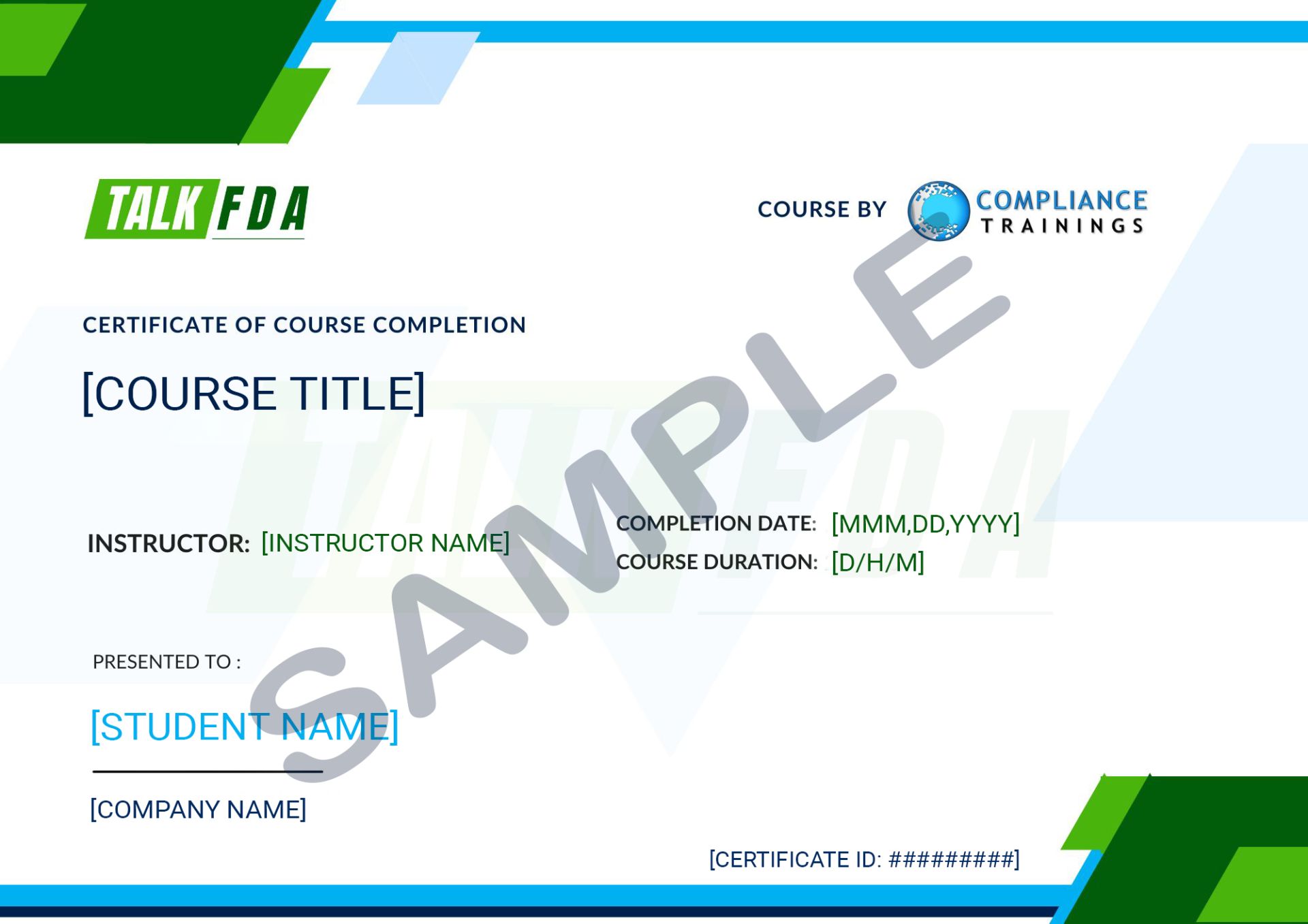
Complete the course and your certificate is unlocked automatically in your learning history.

The challenge with training is rarely signing up. It’s what happens afterward, when access, materials, & certification aren’t accessible from one place.
With TalkFDA Courses, Everything you need Live in One Place.
Simple. Organized. Professional.
Go ahead and Take the Course with confidence.

Our students love us ❤️

“Liked that the session stayed practical. The points on audits and documentation were useful for our group.”

Lead, Information Technology Departments

“Covered the topic without making it overly technical. The examples tied in well with current system compliance work.”

Supervisor, Compliance and Audit Departments

“Presenter knew where to spend time and where to move quickly. That made a difference.”


Director, Quality Assurance


People who took this Course, also viewed