INSTANT STREAMING COURSE
Share:

Analytical Methods Validation - ICH Q14 Overview for Regulatory Approval

This course strengthens the ability to develop, validate, and maintain analytical procedures aligned with ICH Q14 and global regulatory expectations. It supports more reliable submissions, improved method performance, and reduced compliance exposure during inspections and regulatory review. This Course is designed for professionals responsible for analytical procedures, validation activities, quality compliance, and regulatory submissions.

REGISTER FOR THE COURSE

US $190 per learner

30-Days Unlimited Streaming Access

/* Hide default + / - icon */ .accordion-toggle-icon { opacity: 0; } /* Add circle instead */ .accordion-header::after { content: "○"; font-size: 18px; margin-left: auto; transition: 0.2s ease; } /* When open → filled circle */ .accordion-item.active .accordion-header::after { content: "●"; } /* Hide default + / - icon */ .accordion-toggle-icon { opacity: 0; } /* Add circle instead */ .accordion-header::after { content: "○"; font-size: 18px; margin-left: auto; transition: 0.2s ease; } /* When open → filled circle */ .accordion-item.active .accordion-header::after { content: "●"; } .accordion-header::after { content: "◯"; font-size: 18px; transition: transform 0.25s ease; } .accordion-item.active .accordion-header::after { transform: rotate(90deg); }

REGISTER FOR THE COURSE

To Get 30-Day Access to ONLY this Course 

US $190 per learner
  • This course is Included in Subscription Pack
Subscription include access to entire Learning Library
/* Hide default + / - icon */ .accordion-toggle-icon { opacity: 0; } /* Add circle instead */ .accordion-header::after { content: "○"; font-size: 18px; margin-left: auto; transition: 0.2s ease; } /* When open → filled circle */ .accordion-item.active .accordion-header::after { content: "●"; } /* Hide default + / - icon */ .accordion-toggle-icon { opacity: 0; } /* Add circle instead */ .accordion-header::after { content: "○"; font-size: 18px; margin-left: auto; transition: 0.2s ease; } /* When open → filled circle */ .accordion-item.active .accordion-header::after { content: "●"; } .accordion-header::after { content: "◯"; font-size: 18px; transition: transform 0.25s ease; } .accordion-item.active .accordion-header::after { transform: rotate(90deg); }
  • Faculty
    Scott R. Thatcher ‎
  • Duration
    60 Minutes
  • Course ID
    TF2178
  • Ask the Expert
    Included
  • Presentation Handout
    & Templates
  • Assessment
    & Certification Included

About the Course

Analytical procedure validation remains a critical regulatory expectation across pharmaceutical and biotechnology development programs. ICH Q14 introduces a structured approach linking analytical procedure development with validation activities, supporting greater consistency in method performance, scientific justification, and regulatory documentation. Organizations submitting data to regulatory agencies must demonstrate that analytical methods are suitable for their intended use while maintaining accuracy, precision, specificity, and reliability throughout the product lifecycle.


Current regulatory scrutiny continues to focus on inadequate validation practices, poor method transfer controls, and insufficient stability-indicating capability. Failures in these areas can contribute to FDA 483 observations, delayed approvals, product recalls, and post-submission remediation work. This course addresses practical considerations for phase-appropriate validation, risk-based method development, forced degradation studies, and lifecycle management activities aligned with FDA, USP, and ICH expectations. Attention is also given to method verification, reproducibility across laboratories, and maintaining compliance after validation activities are completed.

  • Analytical Validation Decisions Aligned With Regulatory Expectations:

    Organizations are expected to justify analytical procedures with clear scientific rationale and consistent validation data. This course clarifies how ICH Q14, Q2(R2), FDA requirements, and USP expectations influence method development, validation planning, and regulatory submissions. Participants gain practical direction for reducing deficiencies that can trigger inspection findings, review delays, or additional agency questions.

  • Greater Reliability Across Development and Commercial Activities:

    Reliable analytical methods depend on controlled development practices, appropriate validation parameters, and reproducible performance across laboratories. The course explains risk-based approaches for accuracy, specificity, linearity, detection limits, robustness, and stability-indicating capability. It also addresses method transfer, lifecycle management, and phase-appropriate validation strategies needed to support clinical development and commercial manufacturing activities.

Key Areas Covered

  • Analytical method validation principles, regulatory expectations, and core terminology
  • ICH Q14, Q2(R2), 21 CFR Part 211, and USP <1225> requirements relevant to analytical procedures
  • Validation parameters including accuracy, precision, specificity, linearity, detection limits, robustness, and system suitability
  • Risk-based analytical method development and validation planning approaches
  • Phase-appropriate validation strategies supporting Phase I, II, III, and commercial applications
  • Forced degradation studies and stability-indicating method considerations for stability programs
  • Lifecycle management activities supporting continued analytical procedure compliance after validation
  • Method verification, transfer practices, reproducibility expectations, and common FDA 483 findings

Who Must Attend

  • QA/QC Departments
  • Research and Development Teams
  • Analytical Development Professionals
  • Regulatory Affairs Departments
  • Compliance Professionals
  • Manufacturing Departments

Quality training, expert insights, and answers that matter. Know your Expert

SCOTT R. THATCHER

Scott Thatcher is a 20+ year veteran of the pharma and biopharma industry with extensive experience supporting analytical method development and validation activities. He has executed stress studies for hundreds of analytical methods and contributed to multiple regulatory submissions associated with approved drug programs across different delivery systems. His background includes published work in analytical chemistry and photostability studies, along with practical experience interpreting ICH Q1B requirements and supporting regulatory compliance expectations tied to analytical procedures.

If you would like to request a Proforma invoice to sign up for this course. please click here

Commonly Asked Questions About This Subject

The following questions address practical regulatory, compliance, validation, quality, operational, and inspection-related considerations commonly associated with this subject.

How can analytical method validation decisions remain defensible when product knowledge changes after the original validation is completed?

Validation decisions should be reassessed whenever new scientific understanding changes the assumptions that supported the original work. A method that was appropriate during early development may become difficult to defend after formulation changes, expanded impurity knowledge, manufacturing scale up, or revised product specifications.


Documentation should explain why the existing validation continues to support the intended use of the analytical procedure or why additional validation activities became necessary. Reviewers place greater confidence in decisions supported by documented change assessments than statements that the method was previously accepted.


Inspection discussions often focus on whether product knowledge evolved while the validation package remained unchanged. Historical reports lose value when they no longer reflect the current manufacturing process, product understanding, or analytical expectations.


A well documented scientific rationale supported by current evidence is generally more persuasive than relying exclusively on the original validation study. Continued suitability should be demonstrated, not assumed.

What documentation weaknesses create the greatest difficulty during regulatory review of analytical method validation packages?

Validation reports containing acceptable results can still attract regulatory questions when the reasoning behind critical decisions is missing. Reviewers frequently evaluate the quality of scientific justification as closely as the validation data themselves.


Documentation becomes difficult to defend when protocol revisions, acceptance criteria, data exclusions, or analytical calculations cannot be traced to a documented rationale. Gaps between development records, validation reports, and supporting laboratory data often require additional explanation during review.


Inspectors also examine whether conclusions can be reconstructed from the available records. When important decisions depend on institutional knowledge rather than documented evidence, the validation package becomes considerably weaker.


Validation documentation carries greater weight when it explains why decisions were made rather than simply recording that predefined criteria were achieved. Scientific reasoning often determines whether an otherwise acceptable validation package withstands regulatory scrutiny.

When can existing analytical development knowledge justify a reduced analytical method validation strategy?

A reduced validation strategy can be scientifically justified when existing development knowledge addresses the uncertainty that additional validation work would otherwise resolve. Regulatory reviewers generally expect that conclusion to be supported by evidence rather than development timelines or resource considerations.


Documentation should explain why previous development studies, platform knowledge, or comparable analytical experience remain applicable to the specific method and intended use. Historical data generated under different conditions provides limited support unless its relevance is clearly established.


Reviewers often examine whether the reduced approach was supported by a documented risk assessment and whether remaining uncertainties were evaluated before validation activities were scaled back. Unsupported reductions frequently generate additional regulatory questions.


Scientific justification is easier to defend when the existing knowledge is traceable, product specific, and directly linked to the validation strategy. That demonstrates that validation activities were reduced because the remaining risk was understood rather than overlooked.

How should legacy analytical methods developed before ICH Q14 be evaluated for continued regulatory acceptability?

Legacy analytical methods should be evaluated against current scientific expectations rather than automatically revalidated because newer guidance has been published. Regulatory reviewers generally focus on whether the analytical procedure remains suitable for its intended use and continues to generate reliable data.


A structured gap assessment provides stronger support than relying solely on historical validation reports. Product knowledge gained after approval, manufacturing changes, investigation history, analytical technology updates, and long term method performance all contribute to that evaluation.


Reviewers frequently question legacy methods that continue to be used without documented reassessment despite significant changes in products, processes, or analytical understanding. Historical acceptance alone rarely provides sufficient justification for continued reliance.


A documented evaluation explaining why existing evidence remains adequate, or identifying targeted improvements where gaps exist, is generally easier to defend than repeating validation work without a clearly defined scientific objective.

Ready to Strengthen Your Team? Let’s Build Your Training Plan.

Whether you’re looking for a single onsite workshop or a multi-team training series, we’ll help you design a program that fits your goals, timelines, and operational reality.

Your team deserves the clarity.
Your organization deserves the confidence.

Upcoming Courses

Your TalkFDA Webinar Experience

When you reserve your seat, everything is organized for you — from access to certification from one place.

1. Confirmation

You receive a confirmation email and your course appears instantly in your TalkFDA dashboard.

2. Your Course Hub
Your TalkFDA course page becomes your central hub where you can watch the course, access materials, and manage your learning.

3. Access course materials
The presentation handout and other materials can be downloaded inside the Course Player. You could use Discussion feature there to ask your questions.

4. Watch The Streaming and Complete your Course
The course playback will be available on the same course page. You could pause and continue or you can revisit important sections.
5. Earn Your Certificate
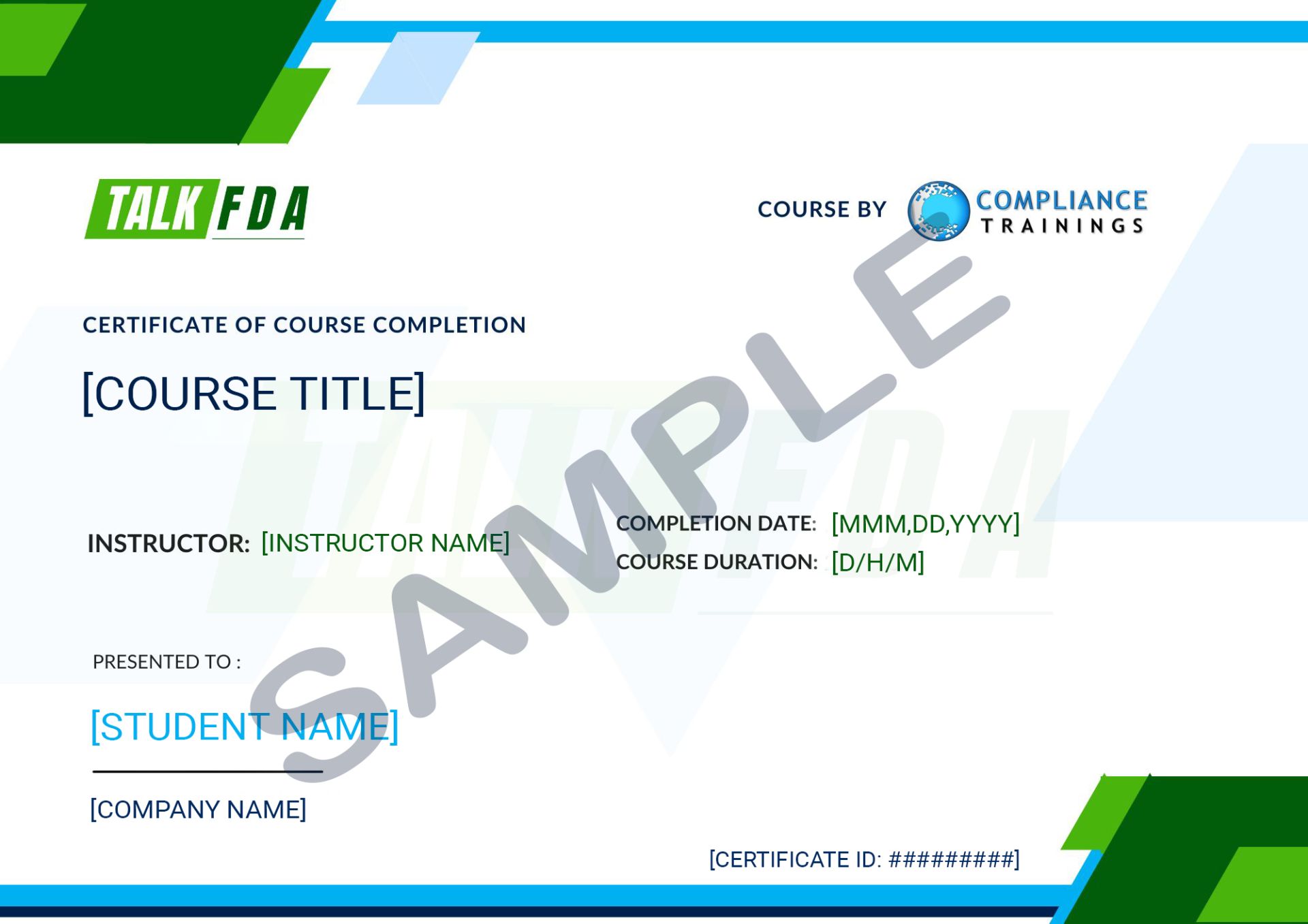
Complete the course and your certificate is unlocked automatically in your learning history.

The challenge with training is rarely signing up. It’s what happens afterward, when access, materials, & certification aren’t accessible from one place.
With TalkFDA Courses, Everything you need Live in One Place.
Simple. Organized. Professional.
Go ahead and Take the Course with confidence.

Our students love us ❤️

A lot of the discussion related well to the method challenges we see in routine work.


Manager, Quality Control

“Flow was good. You could see the structure behind it. Not just information dump.”


Engineer, Manufacturing

“Support team was quite responsive before the session. That made it easier to get aligned internally." 


Compliance Consultant

People who took this Course, also viewed