Regulatory Submissions Training: From Strategy to Execution
Overview
Regulatory submissions training has expanded far beyond understanding submission formats or compiling documentation. Modern submission teams are expected to balance regulatory strategy, technical accuracy, data integrity, cross-functional coordination, and inspection readiness across increasingly complex global environments.
Training today needs to reflect how submissions are actually developed, reviewed, defended, and maintained throughout the product lifecycle.
What Regulatory Submissions Involve Today
Regulatory submissions now span multiple operational and strategic areas, including:
- IND, NDA, ANDA, BLA, and 510(k) pathways
- CTD and eCTD structures
- Global submission planning and regional alignment
- Technical writing and data presentation
- Deficiency responses and agency interactions
- Labeling, lifecycle management, and post-approval changes
As regulatory expectations evolve, submission work increasingly depends on collaboration across regulatory affairs, quality, clinical, manufacturing, and validation functions.
How Training Approaches Differ
Training in regulatory submissions is commonly delivered through several formats:
Topic-specific sessions
Focused on individual areas such as eCTD structure, technical writing, or submission pathways. Useful for targeted learning needs and regulatory updates.
Structured programs
Multi-module or workshop-style formats that walk through submission strategy, compilation, review cycles, and lifecycle management in sequence.
Event-based learning
Conferences and seminars focused on regulatory trends, agency expectations, and evolving submission practices across regions.
Continuous learning models
Ongoing learning environments that connect submissions with quality systems, validation, labeling, inspections, risk management, and change control over time.
Why Strategy Matters as Much as Documentation
One of the most common misconceptions in regulatory submissions training is that success depends primarily on document assembly. In practice, agencies increasingly evaluate:
- The rationale behind decisions
- Data consistency across sections
- Alignment between development, manufacturing, and labeling
- Risk assessment and justification
- Change management throughout the product lifecycle
Training that focuses only on templates or submission mechanics often leaves teams unprepared for real-world regulatory interactions.
Where Training Often Falls Short
Common gaps in submissions training include:
- Overemphasis on format rather than strategy
- Limited discussion of cross-functional coordination
- Minimal coverage of post-approval lifecycle management
- Lack of alignment with global regulatory expectations
- Insufficient focus on how agencies review and question submissions
As products and regulatory environments become more complex, training increasingly needs to support decision-making rather than documentation alone.
A Broader Approach to Validation Training
One approach in the market is a multi-format learning model that combines structured programs, short-form learning, expert-led sessions, in-house team training, and industry events. This allows professionals to build capability across validation stages rather than learning in isolated segments.
Such models are designed to support both individual learning and team-level capability development over time.
A Broader Approach to Regulatory Training
One approach in the market is a multi-format learning model that combines structured programs, short-form learning, expert-led sessions, in-house team training, and industry events. This allows professionals to build capability across regulatory strategy, submission execution, quality systems, and lifecycle management over time.
Platforms like TalkFDA follow this model, supporting continuous learning across interconnected regulatory and operational areas rather than isolated submission topics alone.
Final Perspective

TalkFDA Affiliate Program — Terms & Conditions
1. Joining the Program
- By registering, you agree to these terms.
- Approval of applications is at TalkFDA’s sole discretion.
2. Affiliate Commissions
- Commission Rate: 20% of net sales (after refunds/discounts).
- Commission applies to initial purchase and recurring renewals.
- Payments are made monthly via [payment method] after a 30-day refund period.
3. Tracking & Attribution
- Tracking is done via unique Affiliate IDs.
- Last-click attribution is used (the most recent affiliate link gets credit).
- TalkFDA is not responsible for untracked sales caused by ad blockers, browser issues, or customer error.
4. Prohibited Practices
Affiliates must not:
- Use spam, fake accounts, bots, or misleading claims.
- Misrepresent TalkFDA’s services or guarantees.
- Bid on TalkFDA’s name, brand, or trademarks in paid search ads without prior permission.
- Self-refer (you can’t earn commission from your own purchases).
5. Promotion Guidelines
- Affiliates may promote via websites, blogs, social media, email lists (opt-in only).
- Promotion must be professional and respectful to TalkFDA’s reputation.
- Certain content (adult, hate speech, political, illegal) is strictly prohibited.
6. Termination
- TalkFDA reserves the right to suspend or terminate an affiliate account for any breach of these terms, or if the affiliate’s activity harms TalkFDA’s reputation.
- Any unpaid commissions may be forfeited if termination is due to violation of terms.
7. Liability
- Affiliates act as independent promoters and are not employees of TalkFDA.
- TalkFDA is not liable for indirect, special, or consequential damages related to the program.
8. Changes to the Program
- TalkFDA may update commission rates, terms, or program rules at any time.
- Affiliates will be notified of changes by email or via the Affiliate Dashboard.
9. Governing Law
- These terms are governed by the laws of Canada.
Credit Card required to activate Trial.
You won’t be charged unless you choose to continue after the trial period.
Welcome to TalkFDA Learning
Thank you for your purchase!
Some emails from TalkFDA may be filtered by company email systems.
- Please check the Inbox inside My Space (top right corner).
- Add @talkfda.com to your safe sender list.
Access & Support Information
-
Please check your Spam / Junk folder if you don’t receive emails shortly after purchase.
-
In some organizations, emails may be quarantined by IT security systems — you may need to contact your IT team.
-
We recommend adding @talkfda.com to your Safe Senders / Allow List.
Your TalkFDA Webinar Experience
1. Confirmation
3. Join the Live Training
4. Watch Again Anytime
Everything related to your webinar: access, materials, playback, and certification — lives in one place.
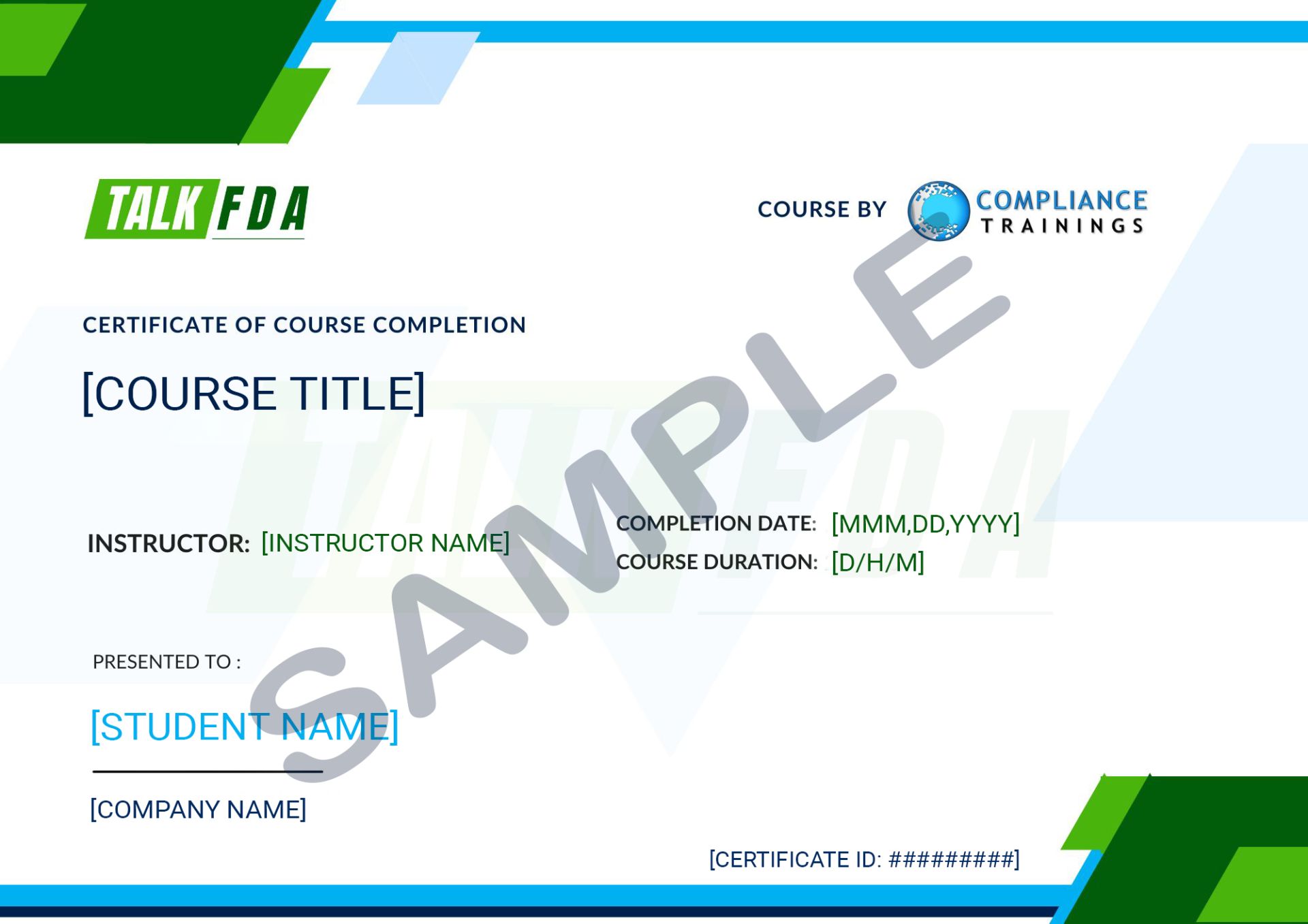
This course will be available to watch as soon as registration is completed.