FDA Inspection Readiness Training: What Inspection-Ready Organizations Actually Practice
Overview
FDA inspection readiness is often treated as a preparation phase that starts shortly before auditors arrive. In reality, most inspection outcomes are shaped much earlier through everyday decisions involving investigations, deviations, change control, validation, documentation practices, management oversight, and how consistently systems behave under pressure.
Organizations rarely struggle because employees cannot recite procedures. Problems usually appear when decision-making becomes inconsistent, investigations lose depth, documentation drifts away from actual practice, or quality oversight weakens gradually over time.
That is why inspection readiness training has changed so much over the past few years. The conversation now extends far beyond interview etiquette or audit preparation checklists. Increasingly, the real question is whether an organization can operate in a way that remains coherent, explainable, and defensible when examined closely.
What Inspectors Usually Detect Early
Experienced inspectors often identify operational weaknesses surprisingly quickly.
Not necessarily through a single missing document or isolated deviation, but through recurring patterns:
- investigations that technically close yet leave obvious questions unanswered
- CAPA systems that generate activity without reducing recurrence
- procedures interpreted differently between departments
- unexplained data inconsistencies
- reactive escalation decisions
- documentation that appears complete while operational reality tells a different story
None of these issues exist in isolation for very long.
Once patterns begin surfacing across multiple systems, inspections tend to shift from transactional review into broader evaluation of organizational control.
Inspections Are No Longer Focused Only on Compliance Tasks
Regulatory inspections increasingly evaluate how organizations think, communicate, escalate problems, and maintain control during uncertainty.
Inspectors now spend significant attention on:
- the reasoning behind quality decisions
- how risks are evaluated over time
- whether recurring problems are truly resolved
- how computerized systems are governed
- how management visibility functions between audits
- whether teams understand procedural intent rather than memorized wording
- how organizations respond when systems no longer behave as expected
This has expanded inspection readiness well beyond QA departments.
Manufacturing, laboratories, validation, engineering, supply chain, IT, and executive oversight all contribute directly to inspection outcomes now, whether organizations formally recognize it or not.
Why Many Training Programs Feel Incomplete
A surprising amount of inspection readiness training still revolves around presentation behavior, mock interviews, scripted responses, or lists of “common inspector questions.”
Those elements may help reduce anxiety. They rarely fix the deeper operational weaknesses inspectors eventually uncover.
Organizations often realize too late that:
- deviations were documented but poorly understood
- CAPA effectiveness checks became procedural exercises
- validation decisions lacked meaningful risk justification
- training records existed without operational consistency
- quality metrics were reviewed but not interpreted carefully
- escalation depended too heavily on individual judgment rather than system discipline
An organization can appear highly organized during opening meetings and still reveal instability within a few hours of inspection activity.
That happens more often than many teams admit.
What Inspection-Ready Organizations Tend to Have in Common
Organizations that remain consistently inspection-ready usually operate differently long before inspections occur.
A few characteristics appear repeatedly:
- investigations remain analytically active instead of administratively closed
- escalation pathways stay predictable under pressure
- management oversight continues outside formal audit cycles
- documentation practices remain stable during workload spikes
- quality systems behave consistently across departments
- personnel understand why procedures exist, not just how to complete them
- training reinforces judgment alongside procedural execution
These organizations often spend less time “getting ready” because inspection readiness has already become part of normal operational behavior.
How Training Approaches Are Changing
Different learning formats now support different inspection-readiness goals.
Short-format sessions are commonly used for warning letter trends, emerging enforcement themes, or focused regulatory updates.
Workshops and internal simulations are often used to strengthen investigation handling, interview management, escalation decisions, and cross-functional coordination during stressful situations.
Some organizations have started moving away from inspection training built around isolated audit exercises. Instead, readiness is being tied more directly to investigations, validation, data integrity, supplier oversight, AI governance, and the daily behavior of quality systems themselves.
Platforms like TalkFDA support this broader learning model through structured programs, short-form learning, expert-led sessions, in-house team training, and operationally grounded regulatory discussions built around real-world GxP environments.
Final Perspective

TalkFDA Affiliate Program — Terms & Conditions
1. Joining the Program
- By registering, you agree to these terms.
- Approval of applications is at TalkFDA’s sole discretion.
2. Affiliate Commissions
- Commission Rate: 20% of net sales (after refunds/discounts).
- Commission applies to initial purchase and recurring renewals.
- Payments are made monthly via [payment method] after a 30-day refund period.
3. Tracking & Attribution
- Tracking is done via unique Affiliate IDs.
- Last-click attribution is used (the most recent affiliate link gets credit).
- TalkFDA is not responsible for untracked sales caused by ad blockers, browser issues, or customer error.
4. Prohibited Practices
Affiliates must not:
- Use spam, fake accounts, bots, or misleading claims.
- Misrepresent TalkFDA’s services or guarantees.
- Bid on TalkFDA’s name, brand, or trademarks in paid search ads without prior permission.
- Self-refer (you can’t earn commission from your own purchases).
5. Promotion Guidelines
- Affiliates may promote via websites, blogs, social media, email lists (opt-in only).
- Promotion must be professional and respectful to TalkFDA’s reputation.
- Certain content (adult, hate speech, political, illegal) is strictly prohibited.
6. Termination
- TalkFDA reserves the right to suspend or terminate an affiliate account for any breach of these terms, or if the affiliate’s activity harms TalkFDA’s reputation.
- Any unpaid commissions may be forfeited if termination is due to violation of terms.
7. Liability
- Affiliates act as independent promoters and are not employees of TalkFDA.
- TalkFDA is not liable for indirect, special, or consequential damages related to the program.
8. Changes to the Program
- TalkFDA may update commission rates, terms, or program rules at any time.
- Affiliates will be notified of changes by email or via the Affiliate Dashboard.
9. Governing Law
- These terms are governed by the laws of Canada.
Credit Card required to activate Trial.
You won’t be charged unless you choose to continue after the trial period.
Welcome to TalkFDA Learning
Thank you for your purchase!
Some emails from TalkFDA may be filtered by company email systems.
- Please check the Inbox inside My Space (top right corner).
- Add @talkfda.com to your safe sender list.
Access & Support Information
-
Please check your Spam / Junk folder if you don’t receive emails shortly after purchase.
-
In some organizations, emails may be quarantined by IT security systems — you may need to contact your IT team.
-
We recommend adding @talkfda.com to your Safe Senders / Allow List.
Your TalkFDA Webinar Experience
1. Confirmation
3. Join the Live Training
4. Watch Again Anytime
Everything related to your webinar: access, materials, playback, and certification — lives in one place.
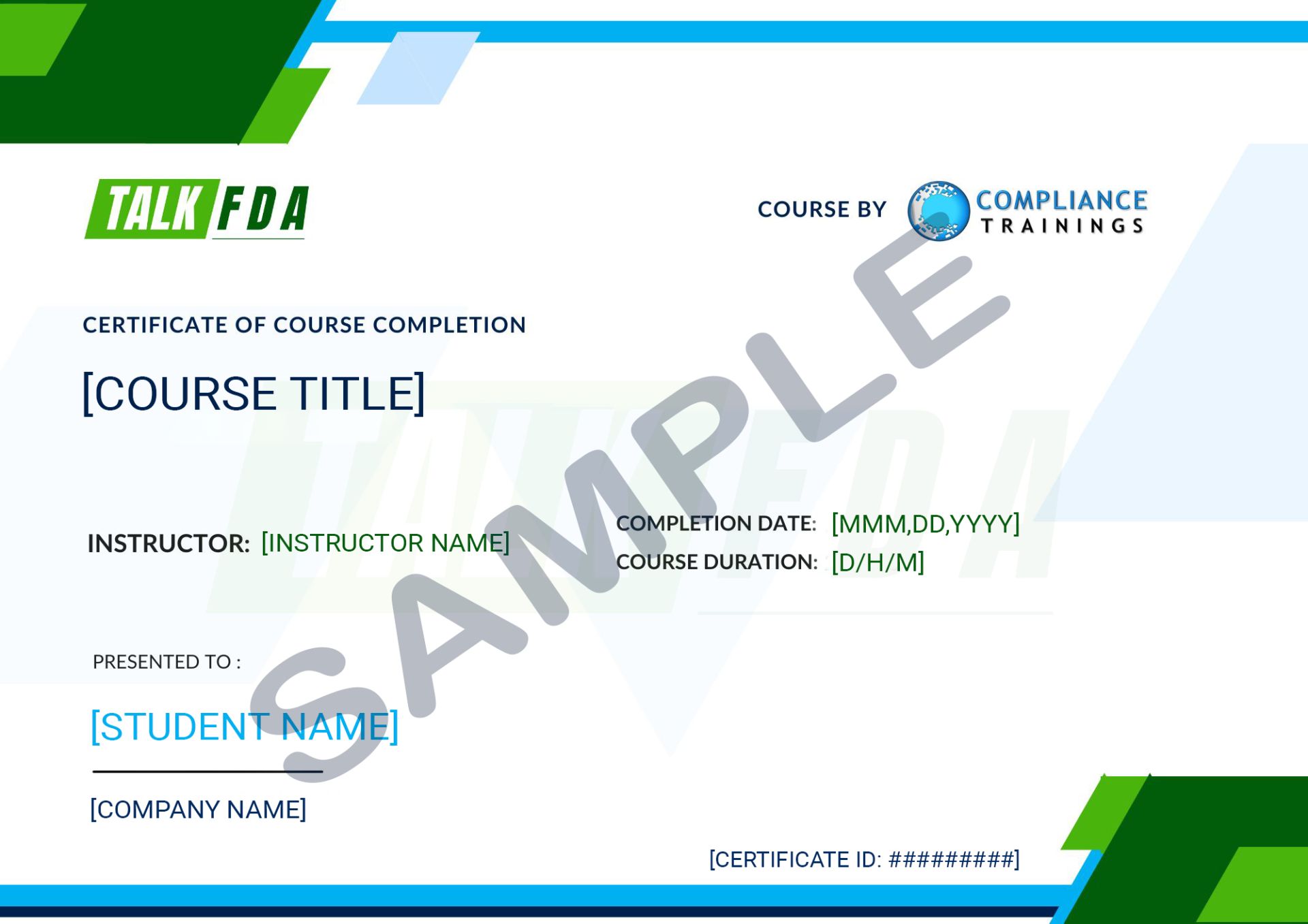
This course will be available to watch as soon as registration is completed.