Usability Engineering / Human Factors
-
Training ID: ELT284
-
Customization: Available
-
Certificate: Included
-
TalkFDA AfterCare™: Included
-
Training Mode: Onsite / Virtual / Streaming
-
Skill Level: Beginner / Intermediate / Advanced
-
Duration: Half-Day / Full-Day / Multi-Day
-
Course Format: Workshop / Masterclass / Bootcamp
Why This Training Matters
Design failures rarely announce themselves during development. They surface later-through use errors, complaints, delayed approvals, or uncomfortable regulatory questions. Teams often underestimate how closely regulators examine user interaction, assuming functionality alone is enough. It isn’t.
Usability Engineering / Human Factors sits directly at the junction of patient safety, design control, and regulatory credibility. Poor task analysis, shallow risk assessments, or informal user testing can undermine an otherwise strong submission. Common gaps include poorly defined user groups, incomplete use-related risk files, and validation studies that fail to reflect real-world conditions.
Operational pressure adds friction. Development timelines shorten, documentation trails behind design changes, and usability evidence becomes retrospective. Regulators expect a clear, traceable logic connecting use errors, mitigations, and validation outcomes. When that logic is missing, approval timelines stretch.
Usability Engineering / Human Factors provides teams with a structured way to defend design decisions using human-centered evidence rather than assumptions.
TalkFDA Elite Training Labs helps teams align design intent, usability validation, and regulatory expectations into a single, defensible narrative.
Common Challenges Companies Face
-
User groups poorly defined or oversimplified
-
Use-related risks inadequately linked to controls
-
Validation studies not reflecting real-use conditions
-
Weak traceability between design changes and usability evidence
-
Labeling relied on as primary risk mitigation
Context Behind This Topic
Usability engineering focuses on how users interact with medical devices, combination products, and digital health solutions under intended and reasonably foreseeable conditions. Global regulators require manufacturers to identify use-related hazards, evaluate user interface risks, and demonstrate that residual risks are acceptable through validation activities. Guidance from FDA, IEC 62366, and ISO 14971 shapes expectations worldwide.
Usability Engineering / Human Factors applies across development stages-from early concept through design transfer-and extends into labeling, training materials, and post-market surveillance. It is not limited to devices alone; drug-device combinations and software-driven interfaces fall squarely within scope.
Teams often struggle because usability evidence is treated as a documentation task rather than an engineering discipline. Validation studies may be poorly designed, user tasks insufficiently defined, or risk controls weakly justified. When inspections or submissions probe these areas, gaps become visible quickly. This topic anchors usability within quality systems, risk management, and regulatory strategy.
Who This Training Is Designed For
Regulatory Affairs (RA), Quality Assurance (QA), Design Control Engineers, Medical Device Development Teams, Human Factors Engineering Specialists, Risk Management Owners, Research & Development (R&D), Validation and Qualification Engineers, Clinical Affairs, Labeling and IFU Development Teams, Technical Documentation Managers, Software Development Leads for Medical Devices, Manufacturing Engineering, Post-Market Surveillance Teams, Product Management Leadership responsible for Usability Engineering / Human Factors
Core Learning Themes
-
User task analysis aligned to real use
-
Designing defensible usability validation
studies -
Documentation strategies for submissions and audits
-
Identifying critical use-related hazards
-
Linking mitigations to user errors
-
Managing usability changes across lifecycle
-
Integrating usability with risk management
-
Regulatory expectations for human factors evidence
-
Presenting human factors evidence to regulators
-
Minor adjustments to these themes may be made following the Clarity & Context Call to align the workshop with your team’s specific needs.
The TalkFDA Elite Training Framework
How We Build Your Training
1. Clarity & Context Call
2. Smart Structuring & Fine-Tuning
3. Focused Delivery
4. TalkFDA AfterCare™ Reinforcement
Customization & Delivery Options
Designed for deeper alignment, richer discussion, and team-wide clarity inside your facility.
Ideal for distributed teams, tight timelines, or phased learning — structured for engagement without compromise.
Local, regional, or international SMEs depending on subject matter, language, and urgency.
We tune the workshop to your context while retaining a strong, proven training architecture.
What Your Team Receives
-
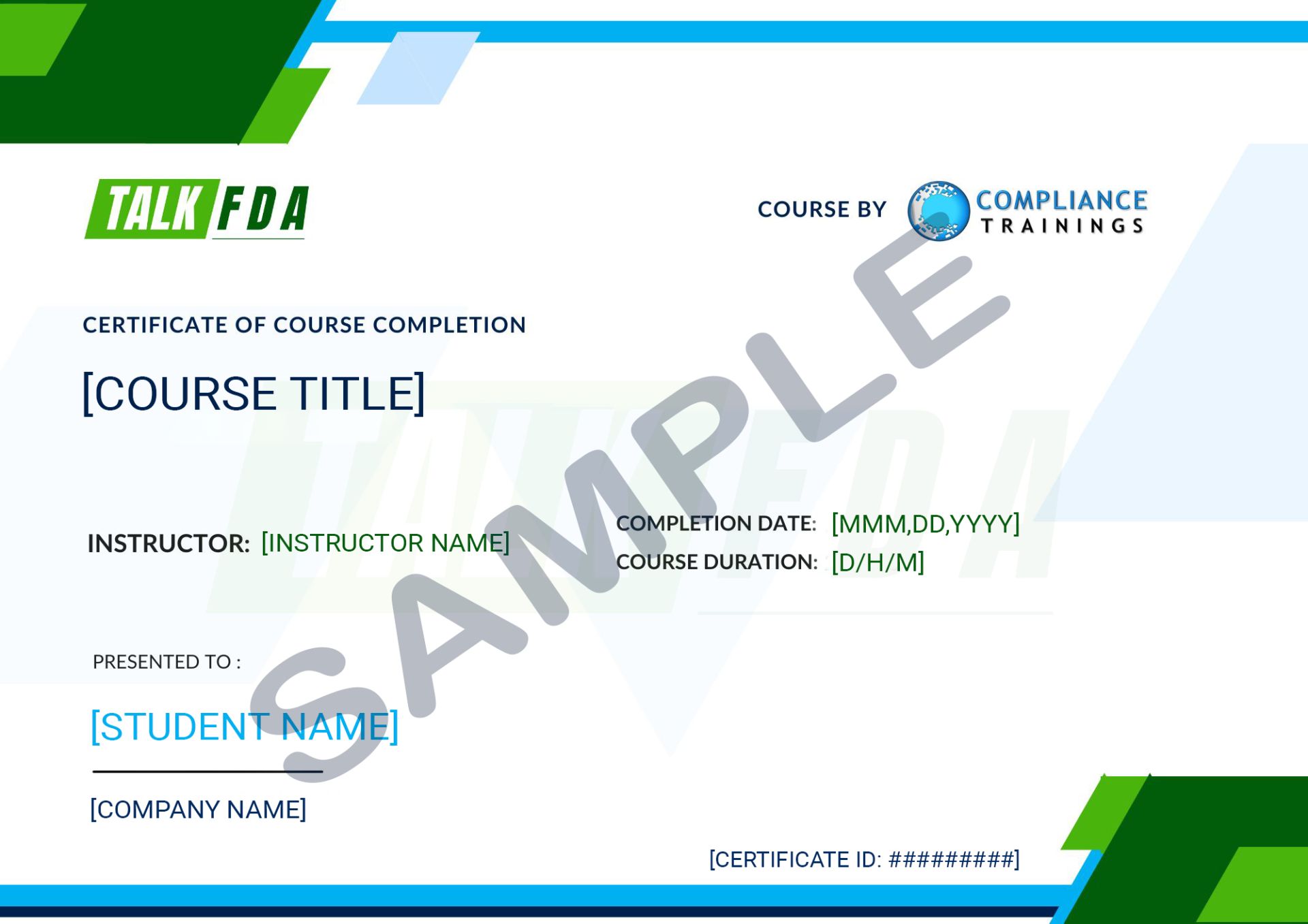
TalkFDA Certificate of Completion for all participants, ready for your training files and audit binders.
-
AfterCare™ reinforcement window (14–21 days post-training)
-
Workshop materials or summaries where applicable
-
Guided insights tailored to your workflows and compliance expectations
FAQs
Do you offer onsite and virtual formats?
Yes. Onsite is recommended for full-team alignment, while virtual options suit distributed teams.
Can the workshop be customized?
Yes — the emphasis and examples are adapted to your facility and team needs.
What is the workshop duration?
Most onsite sessions are full-day or two-day programs. Virtual sessions may use 3–4 hour modules.
What is included in the TalkFDA AfterCare™?
TalkFDA AfterCare™ includes A 14–21 day window for clarification-level questions as your team begins applying the training.
Will participants receive certificates?
Yes, every participant receives a TalkFDA Certificate of Completion.
How much does this training cost?
We’ll share a clear proposal once we understand your needs
Ready to Strengthen Your Team? Let’s Build Your Training Plan.
Your team deserves the clarity.
Your organization deserves the confidence.
Alan Forest
Training Advisor
Aishwarya Meenakshi
Training Advisor
Tina Thompson
Training Advisor
BUILT BY EXPERTS. BACKED BY EXPERIENCE. DESIGNED FOR LIFESCIENCES.
Learn Together. Grow Together. Win Together.
The go-to platform and expert-led community helping life sciences teams stay compliant, confident, and ahead.
Credit Card required to activate Trial.
You won’t be charged unless you choose to continue after the trial period.

TalkFDA Affiliate Program — Terms & Conditions
1. Joining the Program
- By registering, you agree to these terms.
- Approval of applications is at TalkFDA’s sole discretion.
2. Affiliate Commissions
- Commission Rate: 20% of net sales (after refunds/discounts).
- Commission applies to initial purchase and recurring renewals.
- Payments are made monthly via [payment method] after a 30-day refund period.
3. Tracking & Attribution
- Tracking is done via unique Affiliate IDs.
- Last-click attribution is used (the most recent affiliate link gets credit).
- TalkFDA is not responsible for untracked sales caused by ad blockers, browser issues, or customer error.
4. Prohibited Practices
Affiliates must not:
- Use spam, fake accounts, bots, or misleading claims.
- Misrepresent TalkFDA’s services or guarantees.
- Bid on TalkFDA’s name, brand, or trademarks in paid search ads without prior permission.
- Self-refer (you can’t earn commission from your own purchases).
5. Promotion Guidelines
- Affiliates may promote via websites, blogs, social media, email lists (opt-in only).
- Promotion must be professional and respectful to TalkFDA’s reputation.
- Certain content (adult, hate speech, political, illegal) is strictly prohibited.
6. Termination
- TalkFDA reserves the right to suspend or terminate an affiliate account for any breach of these terms, or if the affiliate’s activity harms TalkFDA’s reputation.
- Any unpaid commissions may be forfeited if termination is due to violation of terms.
7. Liability
- Affiliates act as independent promoters and are not employees of TalkFDA.
- TalkFDA is not liable for indirect, special, or consequential damages related to the program.
8. Changes to the Program
- TalkFDA may update commission rates, terms, or program rules at any time.
- Affiliates will be notified of changes by email or via the Affiliate Dashboard.
9. Governing Law
- These terms are governed by the laws of Canada.
Welcome to TalkFDA Learning
Thank you for your purchase!
Some emails from TalkFDA may be filtered by company email systems.
- Please check the Inbox inside My Space (top right corner).
- Add @talkfda.com to your safe sender list.
Access & Support Information
-
Please check your Spam / Junk folder if you don’t receive emails shortly after purchase.
-
In some organizations, emails may be quarantined by IT security systems — you may need to contact your IT team.
-
We recommend adding @talkfda.com to your Safe Senders / Allow List.
Your TalkFDA Webinar Experience
1. Confirmation
3. Join the Live Training
4. Watch Again Anytime
Everything related to your webinar: access, materials, playback, and certification — lives in one place.
This course will be available to watch as soon as registration is completed.