WEBINAR
Share:

Designing Data Integrity Controls for Laboratory Exceptions, Invalidations, and Retesting Decisions

Course is now LIVE. Click below to join the session.

This course helps laboratories establish consistent, scientifically justified controls for exceptions, invalidations, and retesting while strengthening traceability, electronic record oversight, and inspection readiness during regulatory scrutiny.

/* Hide default + / - icon */ .accordion-toggle-icon { opacity: 0; } /* Add circle instead */ .accordion-header::after { content: "○"; font-size: 18px; margin-left: auto; transition: 0.2s ease; } /* When open → filled circle */ .accordion-item.active .accordion-header::after { content: "●"; } /* Hide default + / - icon */ .accordion-toggle-icon { opacity: 0; } /* Add circle instead */ .accordion-header::after { content: "○"; font-size: 18px; margin-left: auto; transition: 0.2s ease; } /* When open → filled circle */ .accordion-item.active .accordion-header::after { content: "●"; } .accordion-header::after { content: "◯"; font-size: 18px; transition: transform 0.25s ease; } .accordion-item.active .accordion-header::after { transform: rotate(90deg); }
REGISTRATION OPTIONS

Live session Plus
Complimentary 30 Days Streaming access

$290  |  One participant (viewer)

$390  |  Team (2 - 5 participants)

$490 |  Team (6 - 10 participants)

REGISTER FOR THE COURSE

US $290 per learner

30-Days Unlimited Streaming Access

/* Hide default + / - icon */ .accordion-toggle-icon { opacity: 0; } /* Add circle instead */ .accordion-header::after { content: "○"; font-size: 18px; margin-left: auto; transition: 0.2s ease; } /* When open → filled circle */ .accordion-item.active .accordion-header::after { content: "●"; } /* Hide default + / - icon */ .accordion-toggle-icon { opacity: 0; } /* Add circle instead */ .accordion-header::after { content: "○"; font-size: 18px; margin-left: auto; transition: 0.2s ease; } /* When open → filled circle */ .accordion-item.active .accordion-header::after { content: "●"; } .accordion-header::after { content: "◯"; font-size: 18px; transition: transform 0.25s ease; } .accordion-item.active .accordion-header::after { transform: rotate(90deg); }

REGISTER FOR THE COURSE

To Get 30-Day Access to ONLY this Course 

US $290 per learner
  • This course is Included in Subscription Pack
Subscription include access to entire Learning Library
/* Hide default + / - icon */ .accordion-toggle-icon { opacity: 0; } /* Add circle instead */ .accordion-header::after { content: "○"; font-size: 18px; margin-left: auto; transition: 0.2s ease; } /* When open → filled circle */ .accordion-item.active .accordion-header::after { content: "●"; } /* Hide default + / - icon */ .accordion-toggle-icon { opacity: 0; } /* Add circle instead */ .accordion-header::after { content: "○"; font-size: 18px; margin-left: auto; transition: 0.2s ease; } /* When open → filled circle */ .accordion-item.active .accordion-header::after { content: "●"; } .accordion-header::after { content: "◯"; font-size: 18px; transition: transform 0.25s ease; } .accordion-item.active .accordion-header::after { transform: rotate(90deg); }
  • Course ID
    TF3245
  • Live Q&A +
    Continued Learning
  • Presentation Handout
    & Templates
  • Assessment
    & Certification Included


Why take this course?

Laboratory exceptions, invalidations, out-of-specification results, and retesting decisions are closely examined during regulatory inspections because weak controls can permit undocumented judgment, selective reporting, or manipulation of analytical data. Data integrity therefore depends on clear governance for how atypical, OOS, OOT, and deviation results are reviewed, when results may be invalidated, and when additional testing is scientifically justified, documented, traceable, and consistently governed.


This webinar examines how laboratories can structure data integrity controls around exception handling, invalidation, retesting, audit trail review, and electronic records. Participants will consider ALCOA+ principles, documentation of investigations and decisions, root cause and CAPA considerations, risk-based review of chromatography and analytical data, and controls that prevent testing into compliance. The discussion also addresses inspection readiness under FDA, MHRA, WHO, PIC/S, 21 CFR Part 11, and EU GMP Annex 11 expectations, including the roles of analysts, supervisors, QA, and laboratory management.

Make More Consistent Invalidation and Retesting Decisions

Build clearer criteria for deciding when laboratory results may be invalidated, when retesting is scientifically justified, and when additional investigation is required. Applying consistent controls to OOS, OOT, atypical results, and deviations helps reduce selective reporting, unsupported decisions, and practices that regulators may interpret as testing into compliance.

Strengthen Traceability Behind Laboratory Decisions

Strengthen the records and oversight surrounding laboratory decisions through ALCOA+ principles, audit trail review, electronic record controls, defined responsibilities, and documented rationale. This supports more transparent investigations and makes it easier to reconstruct who made key decisions, what evidence was considered, and how conclusions were reached during inspections.

Key Areas Covered

  • Governance of OOS, OOT, atypical results, and laboratory deviations
  • Scientifically justified criteria for result invalidation and retesting
  • Controls preventing selective reporting and testing into compliance
  • ALCOA+ principles for laboratory investigations and decision records
  • Audit trail review and electronic record controls under 21 CFR Part 11
  • EU GMP Annex 11 data integrity expectations for laboratory systems
  • Root cause analysis and CAPA considerations for laboratory events
  • Risk-based review of chromatography and analytical data

Who Must Attend

  • Quality Assurance and Quality Systems professionals
  • Computer System Validation (CSV) and Computer Software Assurance (CSA) teams
  • IT and Digital Transformation leaders
  • Regulatory Affairs professionals
  • Manufacturing and Operations leadership
  • Laboratory Informatics and LIMS administrators
  • Clinical Systems and Data Management professionals
  • Data Integrity specialists
  • Cybersecurity and AI Governance teams
  • Compliance officers and auditors
  • Vendors and consultants supporting GxP systems
If you would like to request a Proforma invoice to sign up for this course. please click here

Commonly Asked Questions About This Subject

The following questions address practical regulatory, compliance, validation, quality, operational, and inspection-related considerations commonly associated with this subject.

What makes a laboratory result invalidation difficult to defend even when a plausible analytical error has been identified?

A plausible explanation is not enough if the laboratory cannot demonstrate that the identified error actually affected the reported result. This distinction receives close attention because an unsupported invalidation can remove an unfavorable result from the official record while allowing replacement testing to determine the final disposition.


For example, an analyst may report an injection problem, preparation error, instrument malfunction, or procedural departure. The investigation should establish objective evidence connecting that event to the questionable result. Audit trails, instrument data, sequence information, preparation records, contemporaneous observations, system suitability information, and scientifically appropriate examination of the failure can carry considerable weight.


The investigation becomes vulnerable when the conclusion moves from "this could have caused the result" to "therefore the result is invalid" without closing that evidentiary gap.


Where causation cannot be established, the uncertainty should remain visible. Preserving inconvenient data and acknowledging unresolved questions provides a stronger data integrity position than constructing certainty that the underlying records cannot support.

How can a laboratory distinguish scientifically justified retesting from testing that appears designed to obtain a passing result?

The decision to retest should be supportable before the replacement results are known. Once additional testing begins, a laboratory that has not predefined why it is retesting, how much testing will be performed, and how the results will be interpreted creates an immediate appearance of outcome-driven decision-making.


Inspection scrutiny increases when testing continues after unfavorable results and stops once acceptable results appear. The same concern arises when additional injections, preparations, or samples are described as investigative testing but their results later influence batch disposition without a clearly established purpose.


A defensible record identifies the scientific question the additional testing is intended to answer. It also distinguishes investigative work from formal retesting and preserves the complete sequence of original and subsequent data.


The strongest evidence is often chronological. An inspector should be able to reconstruct what was known when each decision was made and see that the testing strategy was established from scientific reasoning rather than adjusted in response to emerging results.

What should QA question when the same laboratory repeatedly attributes exceptions to analyst error?

Repeated analyst-error conclusions should trigger examination of the laboratory system itself. When similar events occur across analysts or over time, continuing to treat each occurrence as an isolated personnel issue can conceal weaknesses in methods, equipment, training qualification, sample preparation, system configuration, procedures, or supervisory controls.


This becomes particularly difficult to defend when the corrective action repeatedly consists of retraining. Retraining may address a demonstrated knowledge or execution gap, but recurrence after training should cause QA to question whether the original root cause was adequately established.


Trend information carries considerable weight here. Laboratory deviations, OOS and OOT events, invalidated runs, repeat testing, chromatography anomalies, audit trail observations, and instrument problems should be examined together where relevant. Patterns may be invisible when records are reviewed only within their individual workflows.


QA oversight is strongest when it challenges recurring explanations rather than merely confirming that each investigation contains the required approvals. Repetition changes the significance of the evidence.

What can electronic audit trails reveal about laboratory investigations that the final investigation report may not show?

Audit trails can reveal the chronology behind the reported result, including repeated processing, deleted or aborted activities, altered parameters, reintegration, sequence changes, repeated injections, and actions occurring before an exception was formally documented. That chronology can materially change how an investigation is understood.


A polished investigation report may present a logical sequence of events, yet the electronic record can show that analysts or supervisors interacted with the data differently before reaching the documented conclusion. This is why reviewing only the final result and approved investigation can leave significant data integrity questions unanswered.


Inspection friction develops when unexplained electronic activity appears inconsistent with the written narrative. Even legitimate actions become difficult to defend when their purpose was never documented contemporaneously.


Audit trail review should therefore support reconstruction of significant decisions surrounding questionable data. The objective is to understand whether the complete electronic history supports the investigation narrative, including what was attempted, changed, repeated, rejected, and eventually reported.

Your TalkFDA Webinar Experience

When you reserve your seat, everything is organized for you — from access to certification from one place.

1. Confirmation

You receive a confirmation email and your course appears instantly in your TalkFDA dashboard.

2. Your Course Hub
Your TalkFDA course page becomes your central hub where you can join the session, access materials, and manage your learning.

3. Join the Live Training
At the scheduled time, click Join Session and you’ll be connected to the live Webex session with the instructor.

4. Watch Again Anytime
After the session, the playback becomes available on the same course page so you can revisit important sections.
5. Earn Your Certificate
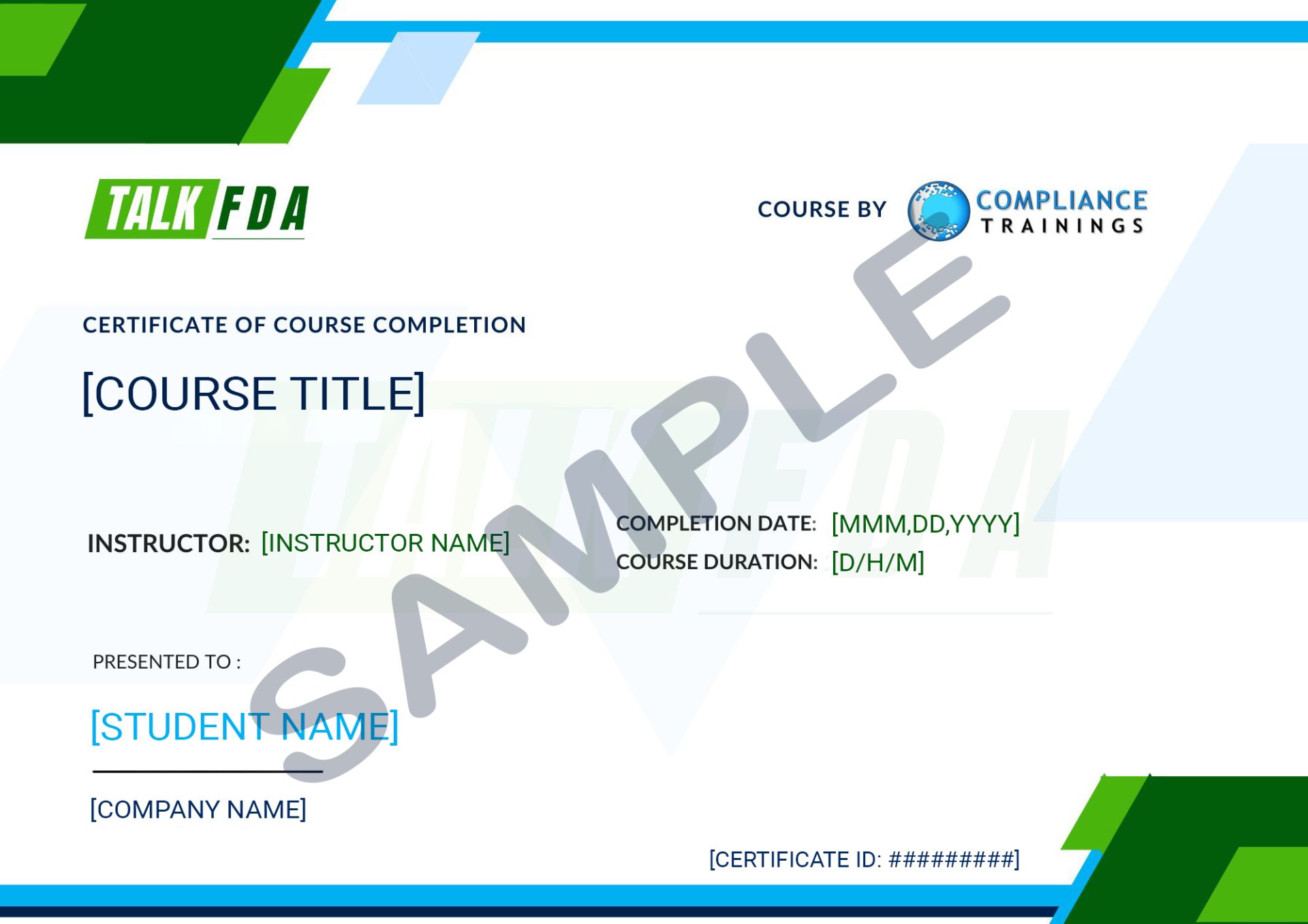
Complete the course and your certificate is unlocked automatically in your learning history.

Everything related to your webinar: access, materials, playback, and certification — lives in one place.
Simple. Organized. Professional.
Go ahead and reserve your seat with confidence.

Built on 20+ years of global regulatory training experience across FDA, EMA, MHRA, and ICH frameworks.
Trusted by professionals across 80+ countries.

Testimonials

This is an upcoming session. Feedback below reflects experiences from similar programs delivered by our expert faculty.

“Session was easy to follow even for non-core team members. That helped.”
- Production Officer
“Good balance. Not too basic, not too deep. Worked well for mixed team.”
- Manager, Regulatory Affairs
“Team found it useful. Especially for aligning understanding across functions.”
- Director, Operations

Ready to Strengthen Your Team? Let’s Build Your Training Plan.

Whether you’re looking for a single onsite workshop or a multi-team training series, we’ll help you design a program that fits your goals, timelines, and operational reality.

Your team deserves the clarity.
Your organization deserves the confidence.

Upcoming Courses

Featured Courses