LIVE WEBINAR
.addeventatc { background-color:#49b40c!important; color:#ffffff!important; font-size:13px!important; padding:6px 20px 6px 12px!important; /* extra right padding for icon */ border-radius:6px!important; display:inline-flex!important; align-items:center!important; gap:6px!important; /* spacing between text and icon */ position:relative!important; } /* Icon fix */ .addeventatc .addeventatc_icon { position:absolute!important; right:10px!important; /* push icon to right edge */ width:12px!important; height:12px!important; background:url(https://cdn.addevent.com/libs/imgs/icon-calendar-fff-t1.svg) no-repeat center center!important; background-size:14px!important; }
Share:

AI-Assisted Post-Market Surveillance and Signal Detection: What Regulators Will Still Expect Humans to Defend

  • Date
    10 July 2026
  • 11.00 AM Eastern Time (US/Canada)
    03.00 PM GMT

Course is now LIVE. Click below to join the session.

This course helps organizations establish clear oversight and decision-making practices for AI-assisted post-market surveillance, ensuring that safety assessments, escalation decisions, and reporting actions remain supported by documented evidence and accountable human review.

/* Hide default + / - icon */ .accordion-toggle-icon { opacity: 0; } /* Add circle instead */ .accordion-header::after { content: "○"; font-size: 18px; margin-left: auto; transition: 0.2s ease; } /* When open → filled circle */ .accordion-item.active .accordion-header::after { content: "●"; } /* Hide default + / - icon */ .accordion-toggle-icon { opacity: 0; } /* Add circle instead */ .accordion-header::after { content: "○"; font-size: 18px; margin-left: auto; transition: 0.2s ease; } /* When open → filled circle */ .accordion-item.active .accordion-header::after { content: "●"; } .accordion-header::after { content: "◯"; font-size: 18px; transition: transform 0.25s ease; } .accordion-item.active .accordion-header::after { transform: rotate(90deg); }
REGISTRATION OPTIONS

Live session Plus
Complimentary 30 Days Streaming access

$190  |  One participant (viewer)

$290  |  Team (2 - 5 participants)

$490 |  Team (6 - 10 participants)

REGISTER FOR THE COURSE

US $290 per learner

30-Days Unlimited Streaming Access

/* Hide default + / - icon */ .accordion-toggle-icon { opacity: 0; } /* Add circle instead */ .accordion-header::after { content: "○"; font-size: 18px; margin-left: auto; transition: 0.2s ease; } /* When open → filled circle */ .accordion-item.active .accordion-header::after { content: "●"; } /* Hide default + / - icon */ .accordion-toggle-icon { opacity: 0; } /* Add circle instead */ .accordion-header::after { content: "○"; font-size: 18px; margin-left: auto; transition: 0.2s ease; } /* When open → filled circle */ .accordion-item.active .accordion-header::after { content: "●"; } .accordion-header::after { content: "◯"; font-size: 18px; transition: transform 0.25s ease; } .accordion-item.active .accordion-header::after { transform: rotate(90deg); }

REGISTER FOR THE COURSE

To Get 30-Day Access to ONLY this Course 

US $290 per learner
  • This course is Included in Subscription Pack
Subscription include access to entire Learning Library
/* Hide default + / - icon */ .accordion-toggle-icon { opacity: 0; } /* Add circle instead */ .accordion-header::after { content: "○"; font-size: 18px; margin-left: auto; transition: 0.2s ease; } /* When open → filled circle */ .accordion-item.active .accordion-header::after { content: "●"; } /* Hide default + / - icon */ .accordion-toggle-icon { opacity: 0; } /* Add circle instead */ .accordion-header::after { content: "○"; font-size: 18px; margin-left: auto; transition: 0.2s ease; } /* When open → filled circle */ .accordion-item.active .accordion-header::after { content: "●"; } .accordion-header::after { content: "◯"; font-size: 18px; transition: transform 0.25s ease; } .accordion-item.active .accordion-header::after { transform: rotate(90deg); }
  • Faculty
    Meredith Crabtree
  • Duration
    90 Minutes
  • Course ID
    TF1417
  • Live Q&A +
    Post-live Continued Learning
  • Presentation Handout
    & Templates
  • Assessment
    & Certification Included


Why take this course?

Post-market surveillance programs are increasingly using AI-assisted tools to support complaint analysis, signal detection, adverse event review, trend evaluation, and large-scale assessment of post-market data. While these technologies may improve the speed and scale of information processing, regulatory accountability for safety decisions remains with the organization. Identifying a potential signal is only one part of the process; determining its significance, evaluating supporting evidence, and deciding whether escalation or reporting is required continue to depend on human judgment and documented rationale.


This webinar examines how AI-assisted outputs can be incorporated into post-market surveillance activities while maintaining appropriate oversight, governance, and regulatory accountability. Participants will evaluate complaint review workflows, signal assessment practices, MDR reporting decisions, escalation criteria, documentation expectations, and safety-related decision-making processes. The session focuses on how organizations interpret, challenge, verify, and justify AI-supported findings when product safety concerns emerge, helping teams strengthen oversight practices and maintain credible, evidence-based post-market surveillance programs within FDA, EU MDR, and other regulated environments.

Improve Signal Evaluation and Escalation Decisions

AI-assisted systems can identify patterns and anomalies across large volumes of post-market information, but determining what requires investigation or escalation remains a human responsibility. Participants will gain practical insight into evaluating signals, assessing available evidence, and applying consistent judgment when deciding whether continued monitoring, reporting, or further investigation is warranted.

Strengthen Regulatory Accountability for AI-Supported Activities

Regulators assess how organizations interpret information, document conclusions, and support safety-related decisions. This session helps teams establish stronger oversight of AI-generated findings, manage challenges such as false positives and data variability, and maintain documentation practices capable of supporting post-market surveillance activities under regulatory review.

Key Areas Covered

  • AI-assisted signal detection within post-market surveillance programs
  • Complaint trends, adverse events, and emerging product safety signals
  • MDR reporting decisions, escalation thresholds, and regulatory obligations under FDA and EU MDR requirements
  • Human oversight of AI-generated findings, recommendations, and safety assessments
  • False positives, data variability, and challenges associated with signal interpretation
  • Documentation practices and evidence supporting post-market decisions
  • Governance expectations for post-market surveillance and safety monitoring programs
  • Determining when evidence supports investigation, reporting, escalation, or continued monitoring

Who Must Attend

  • Quality Assurance (QA) Departments
  • Regulatory Affairs Departments
  • Manufacturing Departments
  • Operations Departments
  • Compliance Departments
  • Post-Market Surveillance Teams
  • Complaint Handling and Vigilance Personnel
  • Product Safety and Risk Management Teams
Meredith Crabtree
COURSE DIRECTOR

Meredith Crabtree

Meredith Crabtree has more than 30 years of experience across regulated industries including pharmaceutical, medical device, laboratory, tissue, and biologics operations. Her work in regulatory assessments, inspections, quality systems, compliance oversight, labeling, distribution, and recall support provides practical perspective on post-market surveillance activities, safety monitoring, and regulatory decision-making expectations.

If you would like to request a Proforma invoice to sign up for this course. please click here

Commonly Asked Questions About This Subject

The following questions address practical regulatory, compliance, validation, quality, operational, and inspection-related considerations commonly associated with this subject.

How should an organization defend a decision not to escalate a potential safety signal identified by an AI system?

The decision must be defended through the evaluation process, not through confidence in the AI system. During inspections, reviewers generally spend very little time discussing how the signal was detected and considerably more time examining why it was dismissed.


Inspection friction appears when documentation contains statements such as "reviewed and determined not reportable" without clearly explaining the supporting rationale. Investigators often expect to see the data reviewed, alternative explanations considered, historical context evaluated, and risk-based reasoning documented.


Records become particularly vulnerable when the AI flagged a pattern repeatedly but no meaningful assessment was performed. In those situations, reviewers often question whether the organization genuinely evaluated the information or simply accepted a preferred conclusion.


Evidence that carries weight includes documented trend analysis, clinical review where appropriate, comparison to known failure modes, discussion of uncertainty, and a clearly recorded justification for continued monitoring rather than escalation. The strength of the decision is usually determined by the quality of the evaluation rather than the outcome itself.

What creates the greatest risk when AI systems become highly accurate at identifying potential signals?

An operational failure point develops when personnel gradually stop exercising independent judgment because the system has been reliable for an extended period. High-performing tools can create a false sense of security that weakens critical review activities.


This pattern often appears slowly. Teams begin accepting classifications, recommendations, prioritizations, or signal rankings with limited scrutiny because previous outputs were generally correct. Over time, human review becomes procedural rather than analytical.


Inspectors become concerned when personnel cannot explain why a signal was categorized a certain way beyond stating that the system identified it. That response suggests the organization has transferred decision-making responsibility without formally acknowledging it.


Stronger oversight is demonstrated when reviewers periodically challenge outputs, investigate unexpected findings, document disagreements, and assess whether system recommendations remain reasonable. Safety surveillance programs are generally more defensible when personnel actively evaluate AI-generated information rather than treating it as authoritative simply because past performance has been acceptable.

When complaint volumes increase dramatically after implementing AI-assisted surveillance, how should management interpret the increase?

A sudden increase in identified signals does not automatically indicate worsening product performance. In some cases, it reflects improved visibility into information that was already present but previously unnoticed.


Documentation concerns arise when organizations immediately react to rising signal counts without determining whether the underlying event rate actually changed. AI-assisted review frequently identifies relationships, clusters, and patterns that manual processes may have overlooked for years.


Reviewers often examine how management interpreted the increase. Did the organization investigate whether detection sensitivity changed? Was the surveillance methodology modified? Were historical baselines reassessed? Were resources adjusted to handle the larger volume of reviews?


Decisions become difficult to defend when management treats newly identified signals as proof of product deterioration without understanding why the increase occurred. Effective oversight requires distinguishing between a true safety trend and an improvement in detection capability. Those are very different conclusions with very different regulatory and operational consequences.

What governance weakness becomes most visible after a significant post-market safety event?

A governance concern frequently emerges when responsibility for surveillance activities is fragmented across departments. Complaint handling, vigilance, quality, regulatory affairs, medical review, risk management, and data analytics may all contribute information without clear ownership of final decisions.


Following a significant event, investigators often reconstruct who reviewed specific information, who had authority to escalate concerns, who evaluated trends, and who decided that no action was necessary. Delays, conflicting interpretations, and undocumented handoffs quickly become visible.


Inspection findings often stem less from missed data and more from uncertainty regarding accountability. Information existed. Signals were observed. Questions were raised. What cannot be clearly demonstrated is who owned the decision process and how conclusions were reached.


Evidence of strong governance includes documented decision authorities, escalation criteria, cross-functional review expectations, meeting records, challenge discussions, and clear ownership of surveillance outcomes. When accountability remains visible throughout the record, organizations are generally in a stronger position to explain and defend their actions after a safety concern emerges.

Your TalkFDA Webinar Experience

When you reserve your seat, everything is organized for you — from access to certification from one place.

1. Confirmation

You receive a confirmation email and your course appears instantly in your TalkFDA dashboard.

2. Your Course Hub
Your TalkFDA course page becomes your central hub where you can join the session, access materials, and manage your learning.

3. Join the Live Training
At the scheduled time, click Join Session and you’ll be connected to the live Webex session with the instructor.

4. Watch Again Anytime
After the session, the playback becomes available on the same course page so you can revisit important sections.
5. Earn Your Certificate
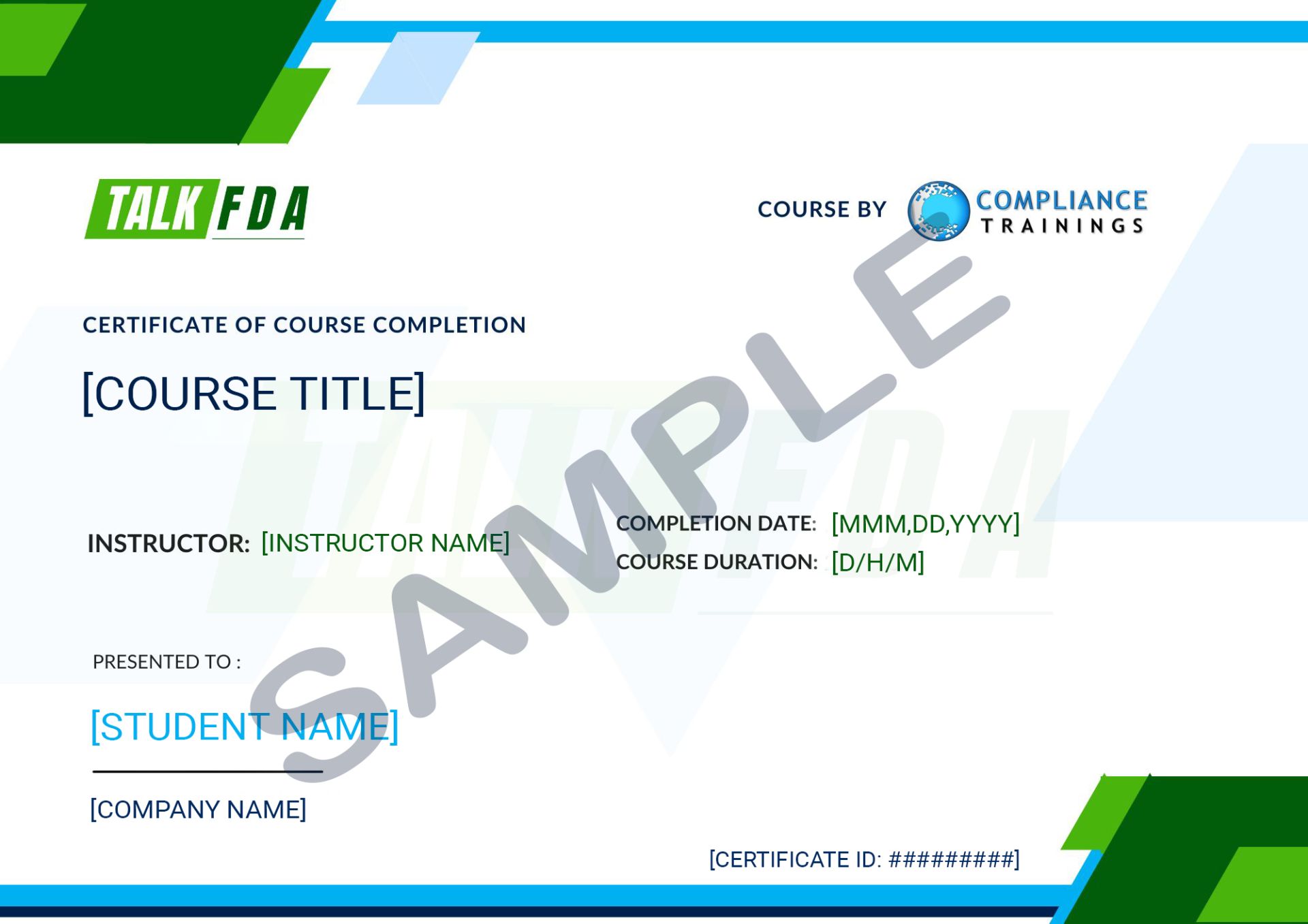
Complete the course and your certificate is unlocked automatically in your learning history.

Everything related to your webinar: access, materials, playback, and certification — lives in one place.
Simple. Organized. Professional.
Go ahead and reserve your seat with confidence.

Built on 20+ years of global regulatory training experience across FDA, EMA, MHRA, and ICH frameworks.
Trusted by professionals across 80+ countries.

Testimonials

This is an upcoming session. Feedback below reflects experiences from similar programs delivered by our expert faculty.

“Session was easy to follow even for non-core team members. That helped.”
- Production Officer
“Good balance. Not too basic, not too deep. Worked well for mixed team.”
- Manager, Regulatory Affairs
“Team found it useful. Especially for aligning understanding across functions.”
- Director, Operations

Ready to Strengthen Your Team? Let’s Build Your Training Plan.

Whether you’re looking for a single onsite workshop or a multi-team training series, we’ll help you design a program that fits your goals, timelines, and operational reality.

Your team deserves the clarity.
Your organization deserves the confidence.

Upcoming Courses

Featured Courses