TalkFDA

Two Companies. One Market. One Winner. The Difference Was Regulatory Strategy

Imagine two MedTech companies developing similar products.


Both have strong technology. Both have experienced teams. Both have access to funding and see a clear market opportunity.

Three years later, one company is generating revenue, collecting real-world performance data, and expanding its market presence. The other is still working through additional evidence requirements, revised development plans, expanded claims, and a more complex regulatory pathway.

What happened?

Most people assume regulatory timelines are determined during the submission and review process. Attention naturally focuses on FDA review cycles, agency questions, inspections, and approval decisions. While those factors certainly influence timing, they are often not the primary reason one product reaches the market years before another.

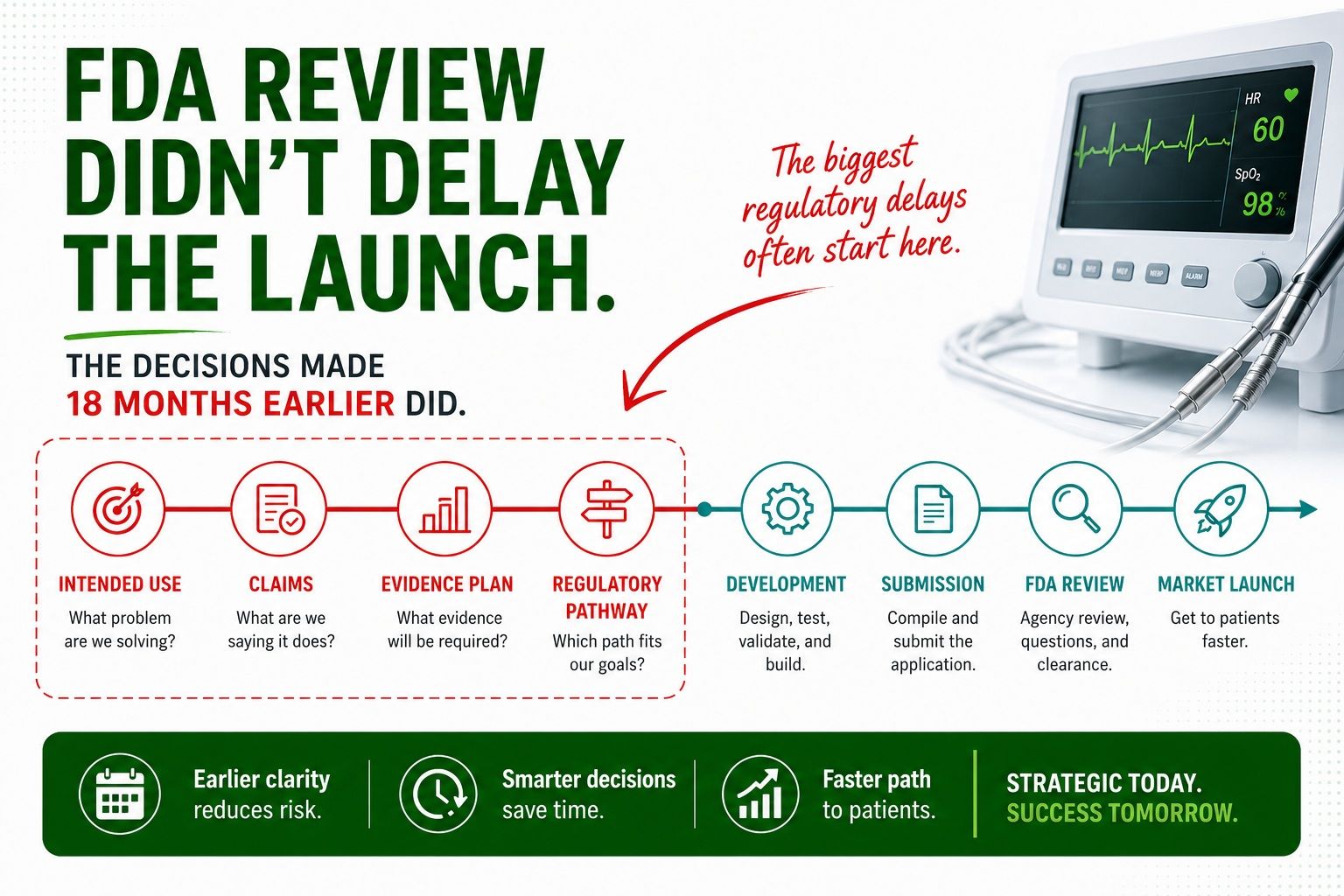
In many cases, the timeline was largely determined much earlier. Decisions about intended use, product claims, target markets, evidence requirements, and regulatory strategy can dramatically affect development timelines long before a submission package is assembled. By the time these decisions begin creating problems, changing course is often expensive, disruptive, and time-consuming.

The companies that consistently move products to market efficiently are rarely relying on shortcuts. More often, they are making strategic decisions early enough to avoid creating unnecessary complexity later.

Regulatory Strategy Is Also Business Strategy

Regulatory discussions are often framed as compliance discussions. In reality, for medical device companies, regulatory strategy is inseparable from business strategy.


The pathway chosen today can influence how much evidence will be required, how long development may take, how much capital must be invested, and when revenue generation can realistically begin. These decisions affect far more than the submission itself.


Consider a company developing an innovative device platform. One team maiy pursue the broadest possible claims immediately, aiming to maximize commercial impact at launch. Another may focus on a narrower indication supported by a more predictable evidence strategy and regulatory pathway.


Both approaches may be valid depending on the circumstances. The important point is that regulatory decisions carry business consequences. They influence timelines, development costs, investor expectations, resource allocation, and competitive positioning.


Organizations that consistently execute well understand this relationship. They evaluate regulatory pathways not only through a compliance lens, but also through the broader context of business objectives, funding realities, and long-term growth plans.

Consider pathway selection alone. A product team evaluating a 510(k), De Novo, or PMA approach is not simply making a regulatory decision. The choice can influence evidence requirements, development timelines, capital needs, and commercial planning. While the appropriate pathway is ultimately determined by the product and its risk profile, understanding those implications early can prevent costly surprises later.

Small Decisions Can Create Large Delays

Many of the delays that frustrate development teams do not originate from major mistakes. They often originate from decisions that appear entirely reasonable at the time.


A marketing team requests broader claims. Engineering introduces additional functionality. Leadership decides to pursue multiple geographic markets simultaneously. Product teams expand intended use based on future opportunities.


Individually, each decision may appear beneficial. Collectively, they can transform the regulatory profile of an entire program.


Broader claims may require additional clinical evidence. Expanded intended use can trigger more extensive testing. Entering multiple markets simultaneously can introduce new technical documentation requirements and different regulatory expectations. What initially appeared to be a modest enhancement can quickly add months of work.


The challenge is that these consequences are rarely visible when decisions are made. They emerge later, when development activities are already underway and flexibility has been reduced.


This is one reason experienced regulatory leaders spend considerable time evaluating downstream impacts. They understand that the true cost of a decision is often much larger than the decision itself.

Write your awesome label here.

Speed Comes From Clarity, Not Urgency

One of the most common misconceptions in product development is that speed comes from moving faster.


In practice, speed often comes from reducing uncertainty.


Development teams lose valuable time when they revisit assumptions, repeat testing, revise documentation, or generate evidence that could have been anticipated much earlier. These delays are rarely caused by a lack of effort. More often, they occur because critical questions were never fully answered at the beginning.


For example, uncertainty around device classification, clinical evidence expectations, software validation requirements, cybersecurity obligations, or submission strategy can create significant downstream rework. Teams may continue development based on assumptions that later prove inaccurate, forcing changes that affect schedules, budgets, and resources.

Consider a company developing a software-enabled medical device. Internal discussions around evidence requirements, cybersecurity documentation, and validation expectations can easily continue for months. In some cases, teams move forward based on internal interpretations that are later challenged. A well-prepared Q-Submission (Q-Sub) meeting with FDA may not provide every answer, but it can significantly reduce uncertainty around key regulatory expectations. The effort required to obtain early feedback is often far less costly than revising protocols, generating unnecessary data, or repeating activities later in development.

Organizations that move efficiently tend to prioritize clarity early. They understand that reducing uncertainty is often more valuable than increasing speed.

The Cost of Trying to Do Everything at Once

Ambition is rarely the problem. The challenge is attempting to accomplish every objective in a single development cycle.


Many organizations want broader claims, additional functionality, larger markets, and future scalability incorporated into the initial launch. The intention is understandable. The resulting complexity is often underestimated.


Every additional objective introduces new requirements. Evidence expectations expand. Risk assessments become more extensive. Validation activities increase. Documentation grows. Regulatory timelines move further into the future.


The most successful organizations are often disciplined about defining what success looks like for the initial launch. Rather than attempting to solve every problem at once, they establish a realistic path to market and create a foundation for future growth.


This approach does not reduce ambition. It sequences ambition.


A product that reaches the market sooner can generate revenue, customer feedback, operational experience, and real-world performance data that support future expansion far more effectively than endless planning. In many cases, those insights prove far more valuable than assumptions made years earlier during development.

The Real Competitive Advantage

When organizations discuss regulatory efficiency, the conversation often focuses on submission preparation, review timelines, or agency interactions.


Those elements matter. However, some of the most significant gains occur much earlier.


Organizations that understand the relationship between regulatory strategy, evidence planning, product scope, and commercial objectives place themselves in a stronger position to move efficiently through development. They avoid unnecessary complexity, reduce rework, and make decisions with greater confidence.


No regulatory strategy eliminates uncertainty. Regulatory agencies, clinical outcomes, market conditions, and technology challenges will always introduce variables. The goal is not to eliminate risk. The goal is to avoid creating unnecessary risk through decisions that could have been evaluated more carefully from the beginning.


In an increasingly competitive MedTech environment, some of the most important regulatory decisions are not made during submission preparation. They are made much earlier, when teams decide what they are building, how they will support it, and what path they will take to bring it to patients.

Before You Finalize Your Regulatory Strategy

Before major development activities begin, ask:

  • What is our shortest credible path?
  • What evidence is truly required?
  • What are we assuming?
  • What are we overbuilding?
  • What can be phased later?
  • What could delay launch?

The answers to these questions often reveal opportunities to reduce regulatory delays long before a submission ever reaches an agency.

The decisions that matter most happen early.